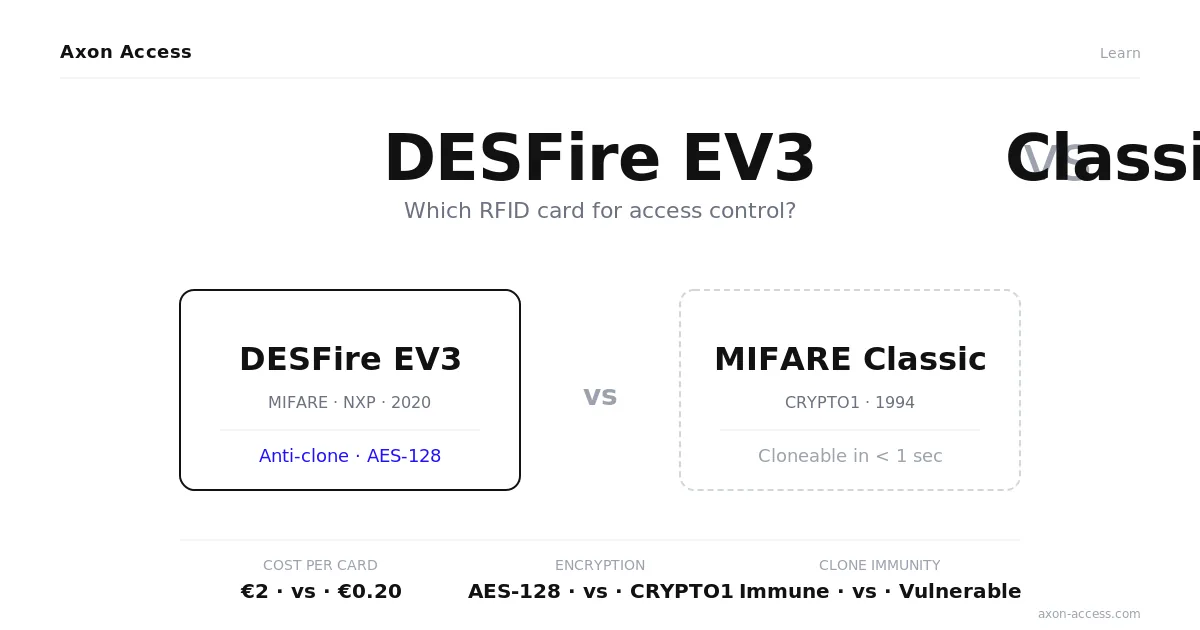
- DESFire EV3: AES-128
- Classic: CRYPTO1 (broken)
- EAL5+ certified
- Dual-mode reader supported
- Migration path included
- Made in Kosovo
- Updated: 2026-06
Answer summary: DESFire EV3 is the right card for any deployment where a cloned credential would matter — offices, hotels with valuables, mixed-use buildings, hospitals, anything with shared back-of-house access. MIFARE Classic remains adequate for low-threat, single-purpose installations such as apartment lobbies and parking-only gates. AXON URX-Secure supports both on the same physical reader, so the choice is a card-procurement decision, not a hardware lock-in.
01 — Quick Answer (TL;DR)
If you are buying readers and cards today for a building that contains anything worth stealing — money, equipment, intellectual property, controlled medication, a server room — buy DESFire EV3. The €2.30 difference per card over MIFARE Classic is the cheapest insurance line item in the project. A Proxmark3 costs €30 and clones a Classic card in under a second; you do not want that to be the weakest link between a corridor and a vault.
If you are wiring up an apartment lobby, a residents-only parking gate, a gym entrance or any other low-risk single-use door, MIFARE Classic is still a defensible choice. The threat model there is "someone walks in behind a resident" not "someone clones a card." Classic is cheap, plentiful and well understood; spending €330 instead of €60 to protect a bicycle storage room is over-engineering.
The decision is per-building, not per-vendor. AXON URX-Secure is a dual-mode reader: the same unit reads MIFARE Classic for backward compatibility and DESFire EV3 for the encrypted path. That means you can pick the card technology per door, mix legacy and new card populations during a migration, and never have to replace a reader twice. The rest of this article walks through the threat model, the real cost arithmetic, and a four-phase migration plan for buildings already on Classic.
02 — What MIFARE Classic Actually Is
MIFARE Classic is a contactless smartcard family Philips (now NXP) introduced in 1994. It ships in 1 KB and 4 KB memory variants, operates at 13.56 MHz under the ISO/IEC 14443-A air interface, and authenticates against the reader using a proprietary stream cipher called CRYPTO1. The chip and the protocol have been in volume production for thirty years; a tray of 200 Classic cards costs roughly €40 to €60 at distributor prices in Kosovo, putting per-card cost in the €0.10 to €0.30 range depending on form factor and quantity.
The honest part nobody likes to say out loud: CRYPTO1 was broken academically in 2008. The Karsten Nohl and Dutch Radboud University papers reverse-engineered the cipher, demonstrated key recovery in seconds, and made the attack practical on consumer hardware. Today a €30 Proxmark3 clone, available on AliExpress, performs a nested attack against a stock MIFARE Classic 1K card and recovers all sector keys in under a second. A 2024 Android phone with an NFC chip and an open-source app like MIFARE Classic Tool can do most of the same — read the card while it is in someone's pocket, write a blank card from the dump, hand it to an accomplice.
So why is Classic still on the market? Because for many deployments the threat model does not include an attacker with a Proxmark3. A residents' parking gate where the worst outcome of a cloned card is "a non-resident parks in someone's spot" is a different problem from a server room. Classic remains the right tool when the credential's job is identification — "this is a resident" — rather than authorisation against valuables. Where Classic is dishonest is when it is sold as "secure" for high-value installations; in 2026 that claim is no longer defensible.
Even with a broken cipher, a Classic deployment can be hardened by checking UID uniqueness, rate-limiting reads across distant doors, and using counter-mode protections on the bus. Practical anti-cloning measures covers that ground in detail. None of those steps make Classic equivalent to DESFire EV3 — they raise the work factor for casual attackers without changing the cryptographic floor.
03 — What DESFire EV3 Brings
MIFARE DESFire EV3, released by NXP in 2020, is the current generation of NXP's higher-security contactless smartcard family. It is also ISO/IEC 14443-A on the air interface — physically the same radio environment as Classic — but the cryptographic stack is entirely different. DESFire EV3 uses AES-128 with mutual authentication, supports up to 28 simultaneous applications per card, provides three secure-messaging modes (Plain, MAC, Full Encryption), and adds EV3-specific features such as transaction MAC, anti-tearing protection on critical writes, and a virtual card architecture for multi-issuer deployments.
The crucial bit is the EAL5+ Common Criteria certification. EAL5+ means the chip has been evaluated against an attack potential that includes lab-grade equipment, fault injection, side-channel analysis and timing attacks. Reproducing a DESFire EV3 card without access to the original key material requires destructive analysis of the silicon — not a tool a casual attacker brings to an apartment lobby. The marketing line "anti-clone" is, for once, accurate: the work factor to clone an EV3 card is closer to "well-funded intelligence operation" than "weekend hobbyist with a Proxmark3."
Per-card cost sits in the €2 to €3 range for printable PVC at mid-volume, dropping toward €1.80 at thousand-card volumes. Fob and keytag form factors run €3 to €5 — roughly ten times the cost of a MIFARE Classic equivalent, and that ratio is the central economic question this article answers.
DESFire EV3 also unlocks deployment patterns Classic cannot do honestly: multi-application cards (access, cafeteria, time-and-attendance on one card), per-application key isolation, and revocable virtual identities. That matters for mixed-use, mixed-vendor environments increasingly common in commercial real estate.
04 — Threat Model Comparison
The cleanest way to choose between Classic and DESFire EV3 is to map them against the attacks each one actually has to survive in your building. The table below is deliberately compact — every row is an attack that has been observed in field deployments in this region or in published academic literature.
| Attack | MIFARE Classic | DESFire EV3 |
|---|---|---|
| Casual cloning with Proxmark3 or NFC phone | Vulnerable — seconds | Resistant — keys never leave card |
| Replay of a captured exchange | Vulnerable — no freshness | Resistant — challenge-response |
| Brute force of authentication keys | CRYPTO1 broken in 2008 | AES-128 infeasible |
| Skim card while in pocket | Partially — UID readable, full key recovery harder | Resistant — mutual auth required |
| Side-channel attack against the card | Published attacks exist | EAL5+ hardened silicon |
| Stolen reader yields site keys | Depends on reader key storage | Depends on reader key storage |
| Lost card used by finder (no PIN factor) | Physical access risk — both | Physical access risk — both |
| Insider clones a card before issuing it | Vulnerable | Hard but procedural — depends on issuance policy |
The last two rows are the limit of what any card technology can do. A lost DESFire card is still a working credential until you revoke it, and an insider at the issuance workstation is a procedural problem the chip cannot solve. The answer is operational — prompt revocation, separation of issuance duties, and a second factor (PIN keypad or biometric) on the doors that justify it.
05 — Cost Breakdown (Real Engineering Numbers)
The most common pushback against DESFire EV3 is "it is ten times more expensive." That is true per card, and almost entirely irrelevant per building. Here is the actual arithmetic for a 100-user building, in 2026 Kosovo distributor prices:
| Line item | MIFARE Classic build | DESFire EV3 build |
|---|---|---|
| 100 cards (per-user credentials) | 100 × €0.20 = €20 | 100 × €2.50 = €250 |
| Reader (per door) | Standard reader ~€40 | AXON URX-Secure ~€80 |
| Spare card stock (typical 20 percent) | 20 × €0.20 = €4 | 20 × €2.50 = €50 |
| Total single-door build (per 100 users) | ~€64 | ~€380 |
The delta is roughly €316 across a card stock that serves the building for five to ten years. Spread over a seven-year lifecycle that is €45 a year, or €0.45 per user per year. The honest framing is not "DESFire is ten times more" — it is "DESFire adds half a euro per user per year for a credential the building cannot trivially clone."
Two qualifications. Multi-door installations split reader cost across users, so the per-user DESFire premium dominates more there. And in pure-residential low-rise buildings with no shared valuables, even €316 can be hard to justify against an HOA budget — the legitimate case where Classic remains the right call.
What does not belong in the comparison: panel replacement. If you are replacing readers anyway because the fleet is end-of-life, the reader-cost line is in your budget no matter which card you choose, and only the card differential matters. That is also the cheapest moment to migrate.
06 — Real-World Recommendation Matrix
Buildings are not all the same threat model. The following table is the recommendation we give integrators in Kosovo and Albania based on what is actually being protected, not on the marketing brochure.
| Building type | Recommendation |
|---|---|
| Single-family home / small low-rise apartments | MIFARE Classic acceptable. Threat is "someone tailgates," not "someone clones." |
| Apartment building with shared amenities (gym, pool, storage) | Classic acceptable as baseline. Move to DESFire if the HOA wants premium positioning or if storage rooms contain bicycles, e-bikes or strollers worth stealing. |
| Office building, co-working space | DESFire EV3 strongly recommended. The cost is invisible against rent and the threat surface includes laptops, monitors, IP and after-hours intrusion. |
| Bank, government, sensitive facility | DESFire EV3 required, plus a second factor (PIN keypad or biometric) on critical doors. The card alone is not enough at this risk level. |
| Hotel back-of-house and staff doors | DESFire EV3. Guest-room locks are a separate system; the card programme this article is about covers staff, contractor and management access. |
| Hospital ward access | DESFire EV3. Privacy regulation and controlled-substance storage push this clearly out of Classic territory. |
| Parking-only gates | Classic fine. UID-level identification is sufficient for "is this a resident car?" |
| Mixed-use (residential plus commercial) | DESFire EV3 across the board. The weakest credential becomes the weakest link, and the residential population shares walls with the commercial tenant. |
Rule of thumb: if your insurance underwriter would ask about access control in the policy review, you need DESFire EV3. If the worst-case loss from a cloned credential is measured in inconvenience rather than money or safety, MIFARE Classic remains a legitimate engineering choice.
07 — Technical Deep-Dive: DESFire EV3 Authentication Flow
For integrators evaluating the protocol, this is what actually happens on the air between a DESFire EV3 card and a properly provisioned reader during AES authentication on an application. The sequence below is the AuthenticateEV2First / AuthenticateAES path; the simpler legacy DES path is omitted because no new deployment should be using it.
- Application selection. The reader sends a SelectApplication command with the 24-bit application identifier (AID). Each DESFire card can host up to 28 applications, each with its own key set.
- Reader generates RndA. A 16-byte random nonce is generated on the reader side. This is the freshness contribution from the reader.
- Reader sends Authenticate command. The reader sends the AES authentication command identifying the key number (0–13) to use for this application.
- Card generates RndB and replies. The card generates its own 16-byte random nonce RndB, encrypts it with the shared application key under AES-128, and returns the ciphertext.
- Reader decrypts and rotates. The reader decrypts the message to recover RndB, rotates it left by one byte (RndB'), concatenates it with its own RndA, encrypts the concatenation with the application key, and sends the result back.
- Card validates RndB'. The card decrypts the reader's message and checks that the rotated RndB' matches the RndB it just generated. If it does, the reader is proven to hold the key.
- Card rotates RndA and replies. The card rotates the received RndA left by one byte (RndA'), encrypts it with the application key, and returns it.
- Reader validates RndA'. The reader decrypts and confirms the card returned the correctly rotated RndA. Both sides have now proven possession of the shared key without ever transmitting it.
- Session key derivation. Both sides derive a session key from a deterministic combination of RndA and RndB. All subsequent commands in this session can be sent in Plain, MAC, or Encrypted mode depending on the application policy.
Three things to notice. The keys never leave either device — they only encrypt nonces. Freshness comes from both sides, so a replay of a captured authentication does not produce a usable session. And the session key is unique per session, so a recording of one authentication gives the attacker no foothold in any future one.
After authentication, EV3 supports three secure-messaging modes: Plain (no further protection), MAC (command and response authenticated, prevents tampering), and Full Encryption (AES-encrypted with the session key). High-security access uses MAC at minimum; stored-value cafeteria credit uses Full Encryption. Application keys, PICC master keys and per-application key sets (up to 14 each) are all rotatable through the master after authentication — which is what makes the migration story credible. When an installer leaves or a population is suspected of leakage, you rotate site keys without re-issuing cards.
08 — What AXON URX-Secure Supports
AXON URX-Secure is the reader Axon Access ships into both kinds of deployments described in the matrix above. It is dual-mode by design: a single physical reader, single firmware, that can be provisioned per-door to operate in any of three configurations.
- Classic-only mode — reads MIFARE Classic UIDs, optionally with a rolling counter on the RS-485 bus to defeat replay attacks. Used during migration on lower-risk doors that have not yet been switched to DESFire-only.
- Dual mode — reads both Classic and DESFire credentials on the same antenna pass. The master decides per credential type how strict to be. This is the mode that lets a building keep operating during a months-long card migration.
- DESFire-only mode — accepts only DESFire EV3 credentials, with full AES mutual authentication. Used on high-security doors as soon as the DESFire population at that door is complete.
The per-door policy is set in the AXON master's management console, not in the reader itself. That matters because it means a single building can run different policies at different doors — the front lobby on dual mode, the server room on DESFire-only, the parking gate on Classic-only — without rolling out three reader SKUs or three firmware loads. The full URX-Secure technical specs walk through the RS-485 architecture, IP65 outdoor variant and bus topology in detail.
Backwards compatibility is not a marketing feature. It is the only honest way to deploy DESFire into the installed base in this region: many buildings in Prishtinë and Tiranë already run MIFARE Classic populations that cannot be swapped overnight. URX-Secure exists so the reader is replaced once and the card population migrates at the pace the building can sustain.
09 — Migration Path from Classic to DESFire
The migration plan below is the four-phase sequence we recommend for buildings already operating on MIFARE Classic. It produces zero access downtime, spreads the card cost across budget cycles, and keeps the high-blast-radius accounts protected first.
Phase 1 — Reader replacement (week 1 to week 4)
Replace existing readers with AXON URX-Secure on a door-by-door schedule. Configure each reader in dual mode on the day of installation. Every existing MIFARE Classic card continues to work the moment the new reader comes online. From the user's perspective nothing has changed — and that is the point of the dual-mode design.
Phase 2 — DESFire issuance for new users (month 1 onward)
Stop ordering MIFARE Classic stock. From the day the readers are deployed, every new tenant, employee, contractor and visitor receives a DESFire EV3 card. Existing Classic cards continue to operate unchanged. The card population shifts naturally as turnover happens, with no forced swap event.
Phase 3 — Bulk re-issuance (month 3 to month 9)
Identify priority groups for early swap: management, administrators, after-hours access holders, master-key equivalents. Replace their Classic cards first because they are the highest-value targets for casual cloning. Run one or two card-swap windows for the general population — often combined with HOA meetings, staff briefings or annual access reviews — where anyone still on Classic exchanges their card.
Phase 4 — Policy tightening (month 9 to month 12)
Once the legacy population is under a working tail, switch high-security doors from "both accepted" to "DESFire only." Lower-risk doors such as residential parking can remain dual-mode indefinitely if that simplifies operations. Rotate DESFire site keys once at the end of the migration to invalidate any key material that may have leaked during the transition.
Why this works: at no point during the twelve months is anyone locked out by a card-technology mismatch. The reader-replacement cost is absorbed once. The card cost is spread across natural turnover plus one or two scheduled swap days. The high-risk accounts are de-risked first. And the building never operates without working access control, which is the only failure mode that actually matters to the property manager.
10 — Pitfalls We've Seen
The following are real engineering mistakes we have either made ourselves or had to fix on someone else's site. None of them are theoretical.
Mixing Classic and DESFire in the same access policy without flagging which is which
If the master treats a Classic UID and a DESFire credential as interchangeable rows in the same access table, you have lost the security benefit at any door the Classic user can also reach. The fix is policy-level: tag every credential with its technology and let the per-door policy decide which technologies are acceptable. URX-Secure exposes this distinction to the master; many third-party panels do not, which is one of the reasons we recommend keeping the credential decision inside the AXON stack.
Provisioning DESFire EV3 cards in "Classic emulation" mode
DESFire chips can be configured to present themselves as a fixed UID for backward compatibility, and some installers reach for that switch to avoid changing the master database. Doing this voluntarily throws away the entire reason for using DESFire — the card is now indistinguishable from a Classic card on the wire. If you needed to spend €2.50 per card, you needed the authentication; turning it off is a procurement decision dressed up as a configuration decision.
Not rotating DESFire master keys after an installer or admin leaves
Site keys are only secret as long as everyone who has held them is still trustworthy. After a personnel change, key rotation is operationally cheap on DESFire EV3 (no card replacement, just a session against each card) and operationally essential. Skipping it is security theatre — the cards are cryptographically strong, but the keying material is in someone's ex-laptop.
Buying "DESFire compatible" no-name cards from unverified suppliers
The market has a long tail of cards advertised as "DESFire compatible" that are not EAL5+ silicon, are not from NXP, and in some cases are simply rebranded Classic chips with a DESFire-looking marking. These cards may pass a basic reader check and then fail catastrophically on the secure-messaging modes that justify the technology. Buy DESFire EV3 from documented NXP supply chains; the per-card premium for genuine silicon over questionable silicon is small.
Issuing the same DESFire card to multiple users
Shared parking permits, shared cleaning credentials, "the office card" — every shared card defeats the audit log and prevents individual revocation. If three cleaning staff share one card, you cannot revoke a specific person; you have to revoke the card and inconvenience everyone. The cost of issuing three cards is €7.50; the operational cost of one shared card is much higher the first time you need to remove one user.
For a deeper treatment of the cloning attack surface — and the specific countermeasures that apply to both Classic and DESFire deployments — see More on RFID cloning threats and the practical companion piece on preventing RFID cloning in access systems.
11 — Frequently Asked Questions
Can DESFire EV3 cards be cloned?
Not in any operationally meaningful sense. AES-128 with mutual authentication and per-application keys, plus EAL5+ silicon hardening, means cloning requires destructive lab analysis. A €30 Proxmark3 that clones MIFARE Classic in under a second produces nothing usable against a properly provisioned DESFire EV3 card.
Do I need to replace my readers to use DESFire?
If your existing readers are MIFARE Classic only, yes — the radio is compatible but the cryptographic stack is not. AXON URX-Secure is dual-mode by design, so you replace readers once and migrate cards gradually without a second hardware swap.
How long do DESFire EV3 cards last in real use?
Typically seven to ten years. Failure modes are dominated by physical damage (wallet wear, hole-punching for lanyards) rather than electrical wear-out. NXP rates the EEPROM at 500,000 write cycles minimum, far above any access deployment will ever consume.
Are smartphone NFC credentials the same as DESFire?
No. Smartphones use NFC Host Card Emulation to imitate a card, but key material lives in the phone's secure element or in the cloud — not in a DESFire chip. The user experience can be similar; the lifecycle, provisioning and revocation are different.
Will Apple Pay or Google Pay work with my access reader?
Not without explicit integration. Apple Pay and Google Pay use proprietary wallet protocols on top of NFC, not raw DESFire APDUs. Supporting them requires a reader certified for that wallet ecosystem — a separate product category from a building access reader.
What happens if a user loses a DESFire card?
You revoke that card's UID in the management system; the site keys remain valid for every other card. Anyone who finds the lost card sees it rejected at the authorisation step. Because keys never leave the card, the loss does not compromise the site.
Is DESFire EV3 future-proof?
For the realistic ten-year horizon of a building access deployment, yes. AES-128 is the standard modern symmetric cipher and is not under credible classical attack. NXP has a public roadmap and a track record of backward compatibility between EV1, EV2 and EV3.
Does EV3 work with older EV1 or EV2 readers?
Yes, in its default mode. EV3 is backward compatible at the protocol level with EV1 and EV2 application sets. You lose EV3-specific features such as transaction MAC, but the basic authentication path keeps working — useful during a phased reader rollout.
12 — Choosing the Right Card for Your Site
If you are sizing a new access deployment in Kosovo, Albania or the wider region, we can help you decide which doors deserve DESFire EV3 and which can stay on Classic — and price out the cards, readers and migration calendar accordingly. The decision is rarely "DESFire everywhere" or "Classic everywhere"; it is usually a per-door policy on a single fleet of dual-mode readers, which is exactly what AXON URX-Secure is built for.
Looking for a broader view of the AXON architecture this reader fits into? The technical documentation hub covers every module — cabin controllers, floor nodes, masters, and bridges — at the same level of engineering detail as this page.
13 — Related Guides
- AXON URX-Secure — Full Technical Specs — Dual-mode Classic / DESFire reader with RS-485 to master, anti-clone detection, IP65 variant.
- More on RFID Cloning Threats — How casual cloning attacks work against MIFARE Classic and why DESFire EV3 changes the game.
- Preventing RFID Cloning — Practical countermeasures for live deployments — key rotation, anti-clone detection, policy hygiene.
- AXON Node — Encrypted CAN Bus — The floor-node counterpart to URX-Secure, bridging RS-485 to the AES-128 encrypted CAN bus, with anti-replay discussion.
- Back to Technical Documentation Hub — All twelve AXON product deep-dives in one index.
References and Standards
- NXP MIFARE DESFire EV3 — product page and technical documentation
- ISO/IEC 14443 — Proximity contactless integrated circuit cards
- Common Criteria portal — EAL5+ certification scheme
- Nohl et al. — Reverse-engineering a cryptographic RFID tag (MIFARE Classic, 2008)
- Radboud University — Pickpocketing MIFARE Classic cards (academic paper)