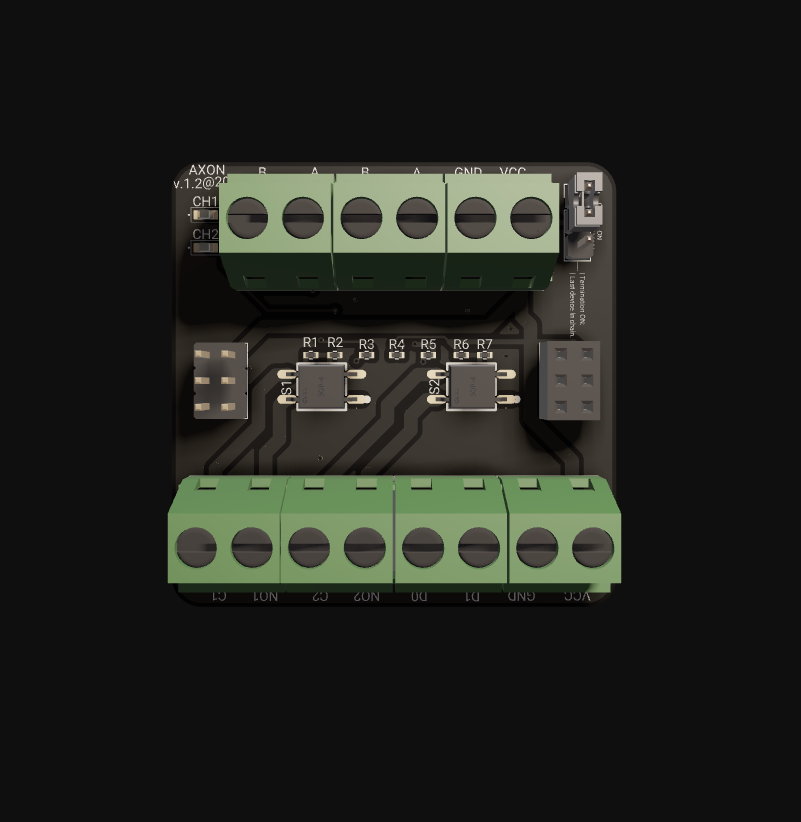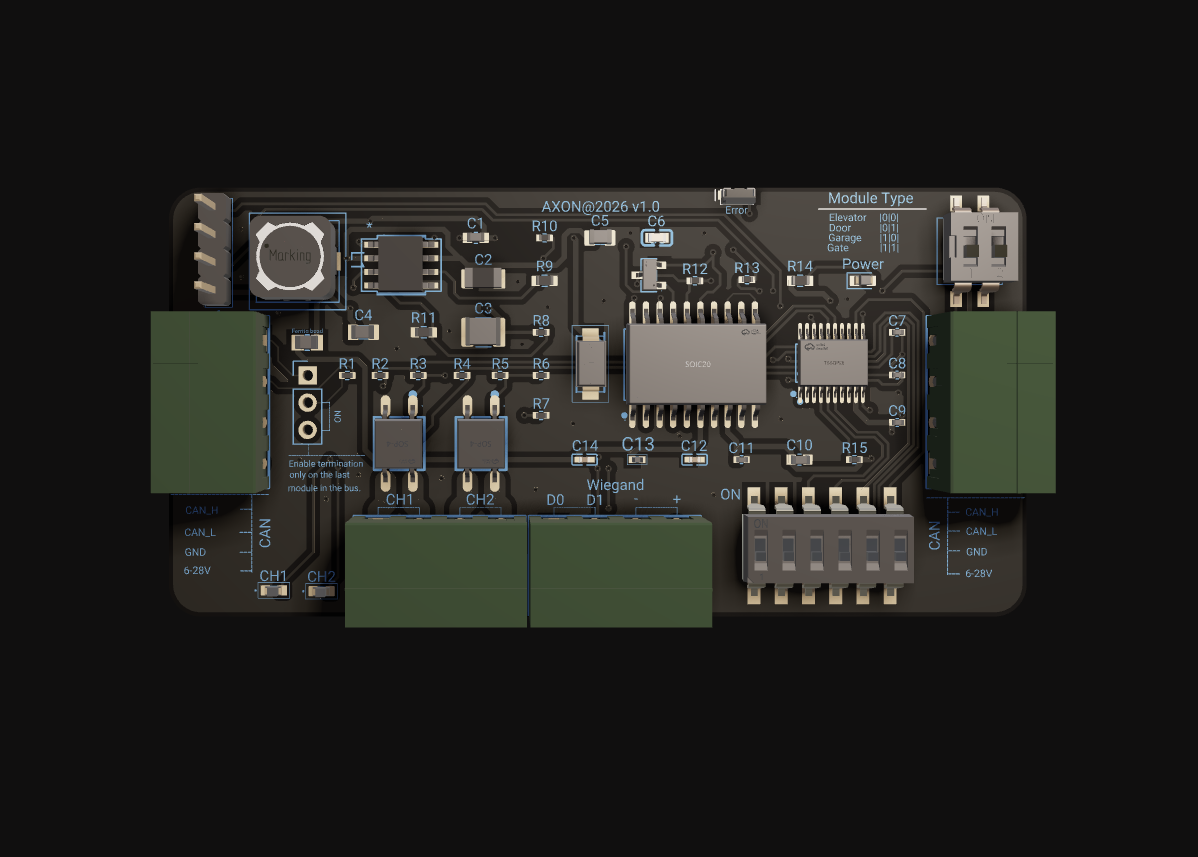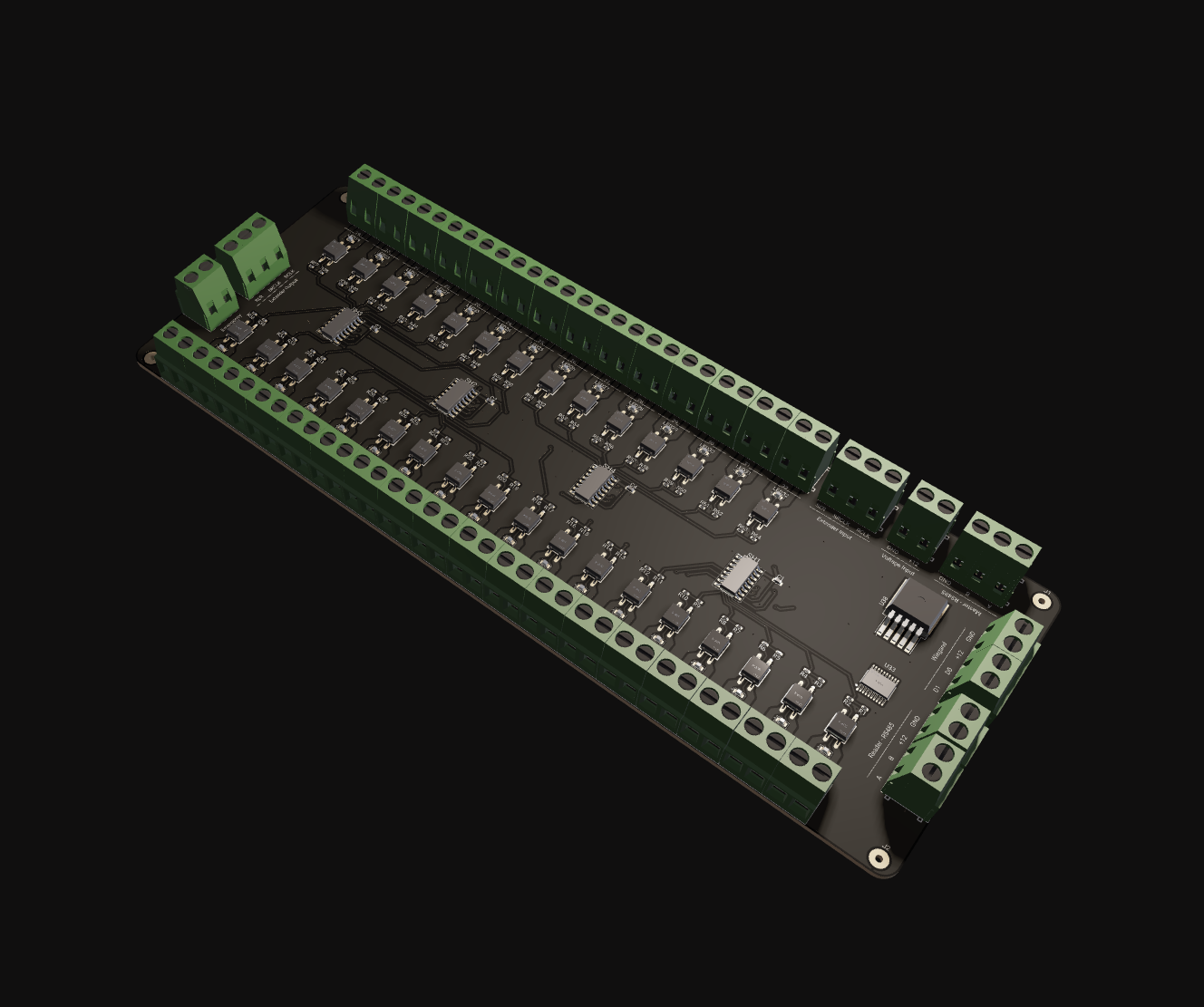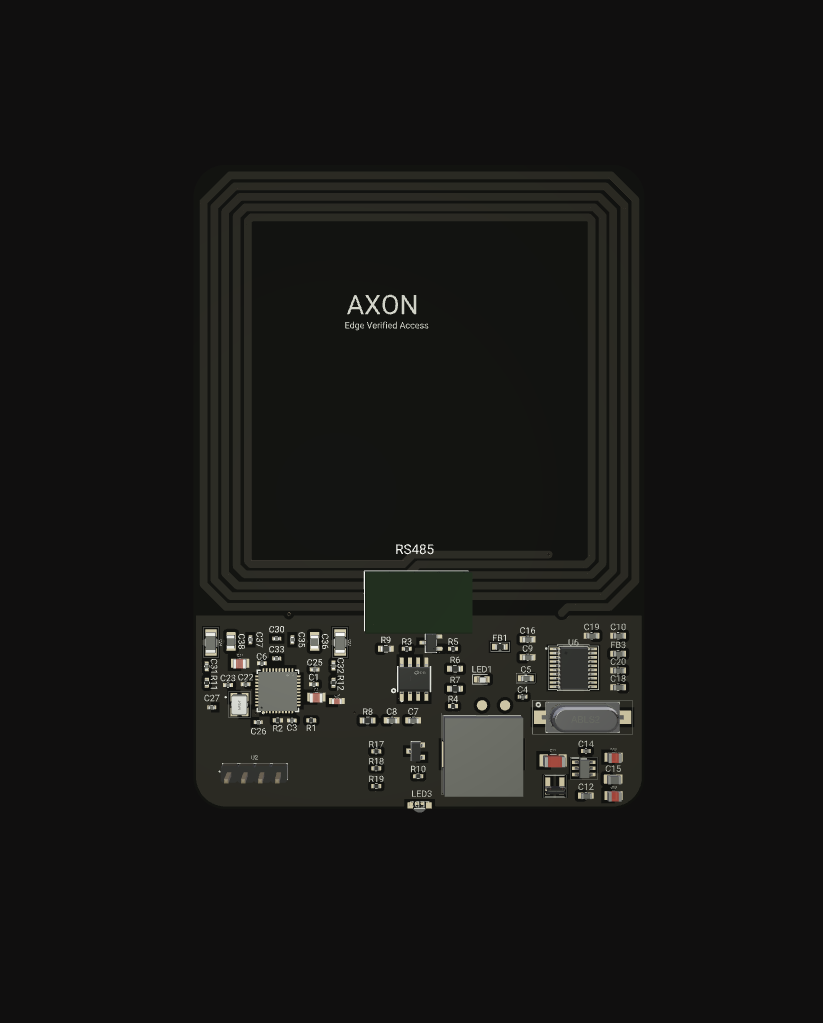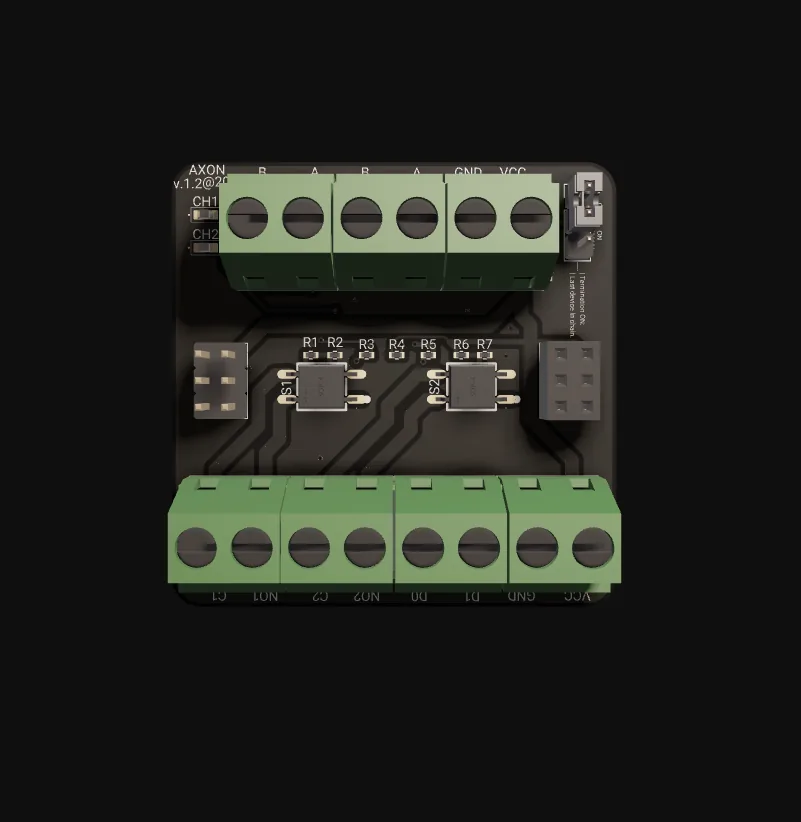
- Role: Relay expansion
- Outputs: 2 relays (NO/NC each)
- Bus: AXON BUS
- Commanding: Independent / Shared
- Power: 12 V DC
- Availability: In stock
Answer summary: AXON SC-E is a dual-relay add-on expansion module. It adds two independent relays — each with NO and NC contacts — to an existing AXON access control installation. Relays are commanded over the AXON BUS, independently or together, from the AXON Master or via local logic. The module is designed to drop into an existing topology without changing the main controller, which keeps tested behavior and policies intact. Powered from 12 V DC. In stock.
01 — What AXON SC-E Does in the System
AXON SC-E is the standard unit of relay expansion in the AXON access control topology. Its job is to add two more independently controllable contact outputs to an installation that already exists and already works, without forcing a redesign of the main controller, the bus addressing model, or the access policy that lives on the Master.
Each relay on the SC-E is independent. They have their own AXON BUS commanding, their own state, and their own NO/NC contact set. In the default configuration, the two relays are addressed and driven independently: the AXON Master can command Relay 1 active while Relay 2 stays inactive, or any other combination. A shared mode is available where both relays are driven by a single command, for situations where the two outputs are part of a single logical action.
The architectural reason this matters is operational: most access systems are not built in a single shot. A residential building adds a garage barrier two years after first occupancy. An office takes on a new tenant whose floor needs a second locking arrangement. A hotel adds a staff-only utility door after a year of operation. In every case, the desired outcome is not "re-engineer the controller" — it is "add the output, keep everything else working." SC-E is shaped to be that minimal addition.
A typical operational flow looks like this: a credential is presented at a reader; the AXON Master evaluates against permission policy; the policy says "release Door X" where Door X is wired to one relay on an SC-E module; the Master sends a command on the AXON BUS addressed to the relevant SC-E; the SC-E energises the appropriate relay; the door releases; when the timed release ends, the relay de-energises and the door re-locks. Nothing about the main controller, the existing readers, or the existing topology changes to make this work.
02 — Required Components
SC-E is intentionally a small unit of expansion. The components involved in deploying one are:
| Part | Role | Notes |
|---|---|---|
| AXON SC-E module | Dual relay expansion | 2 relays, each NO/NC, commanded over AXON BUS. |
| AXON Master (existing) | Commanding authority | Already deployed; SC-E is added as a new bus target with no Master reconfiguration of the main control flow. |
| AXON BUS (existing) | Communication backbone | SC-E joins as one more addressable node on the existing bus. |
| 12 V DC supply | Local power | Stable 12 V at the module location, sized for both relays active simultaneously plus headroom. |
| Load wiring | The actual device being switched | Door strike, maglock, barrier, indicator, alarm panel — wired to NO or NC as the failure-mode design requires. |
| Enclosure | Physical mount | Standard cabinet or DIN-rail enclosure depending on installation. |
Why these specific parts
The relays themselves follow the general-purpose electromechanical relay specifications in IEC 61810-1, with NO/NC utilisation-category ratings declared per IEC 60947-5-1 for low-voltage control circuit devices. The choice to provide both NO and NC contacts on each relay is what makes SC-E a general-purpose expansion module rather than a single-use one. A maglock typically wires to NC so that loss of power releases the door — the fail-safe behaviour required by life-safety codes in most regions for emergency egress. A door strike often wires to NO so that loss of power keeps the door locked. Two relays each exposing both contact forms means a single SC-E can handle one of each, without forcing the integrator to predict the failure-mode design at purchase time.
The decision to keep the main controller untouched is more than convenience. In a regulated environment — hospital, school, multi-tenant office — re-opening the main controller configuration means re-validating the entire access policy, which is far more expensive than the actual electrical work. By scoping SC-E as a strictly additive module, that re-validation is avoided: the existing tested policy continues to apply, and the new outputs are governed by the same policy framework with no change to the Master's underlying logic.
03 — How the SC-E Works End-to-End
- Trigger event. Some upstream event in the AXON system warrants a relay action — typically a successful credential authentication, a scheduled lock/unlock, an emergency override, or a manual command from the Master.
- Master policy evaluation. The AXON Master evaluates the event against its current permission policy, time windows, and lockdown state, exactly as it does for any other relay action in the system.
- BUS command. The Master issues an AXON BUS command addressed to the relevant SC-E module and the specific relay (Relay 1, Relay 2, or both in shared mode).
- SC-E receives. The SC-E module receives the command on the bus, validates it, and energises (or de-energises) the addressed relay.
- Contact change. The relay's NO contact closes / NC contact opens (or the reverse on de-energising). The wired device — strike, maglock, barrier, indicator — responds.
- Timed release. If the command was a timed pulse, the SC-E releases the relay at the end of the configured window. Hold-state commands keep the relay energised until explicitly released.
- Confirm and log. The SC-E confirms the state change back on the AXON BUS. The Master logs the action in the central audit, identifying which module, which relay, by which trigger, and at what time.
Independent commanding means steps 3–7 happen per relay. Shared commanding ties Relay 1 and Relay 2 to a single command and a single state change. The chosen mode is part of the SC-E's deployment configuration and is selected when the module is added to the installation.
04 — Communication Architecture
SC-E on the AXON BUS
From the Master's perspective, SC-E is just another addressable node on the AXON BUS. The bus uses balanced differential signalling per TIA-485-A (RS-485), which is the standard physical layer for multi-drop industrial busses. It receives commands, it confirms state changes, it participates in the bus's overall framing and addressing model. There is no special protocol for "expansion modules" — that uniformity is the entire reason adding an SC-E does not require changes to the main controller. The Master's command-issuing code path is the same one used for any other relay target on the system.
Central vs local commanding
Most commanding is central: the AXON Master evaluates an access event and dispatches the command. Local commanding is supported for cases where the relay action is part of a chained flow handled by other modules on the bus rather than being dispatched directly from the Master. Either way, the SC-E behaves identically — it receives a valid bus command and acts on it. The decision about who issues the command lives at the system-design layer, not in the SC-E itself.
Why no separate cabling
SC-E does not introduce its own cabling, its own controller, or its own audit log. It is one more bus node on existing wiring. This is deliberate: every new cable in a building is a future maintenance liability, and every new controller is a future divergence in policy. By riding the existing bus, SC-E inherits all the existing infrastructure and stays under the existing audit umbrella.
05 — Interface Layout
| Group | Function | Notes |
|---|---|---|
| Relay 1 — COM / NO / NC | First switched output | Independent contact set. Wire load to NO or NC according to the desired failure-mode behaviour. |
| Relay 2 — COM / NO / NC | Second switched output | Independent of Relay 1 in default (independent) commanding mode. |
| AXON BUS A / B | Bus communication | Differential pair to the existing AXON backbone. |
| +12 V DC IN | Module supply | Powers logic and relay coils. |
| GND | Module ground | Tie to system ground at a single point to avoid loops. |
| Mode select (Independent / Shared) | Commanding mode | Configuration of how Relay 1 and Relay 2 respond to commands. |
| Address | Module bus address | Each SC-E has a unique address on the AXON BUS. |
The pinout is conservative and designed for standard electrician familiarity: COM/NO/NC on each relay is the same convention used on common industrial relays, so an installer used to wiring control panels does not need product-specific training to land the load side cleanly.
06 — Security and Robustness
Bus-level security
SC-E participates in the AXON BUS the same way every other AXON module does, and inherits the bus's framing, addressing, and any encryption the platform applies. The module itself stores no user credentials and no permission state; everything authoritative lives on the Master.
Fail-mode behaviour by wiring
The failure-mode behaviour of an SC-E-controlled output is determined by how the load is wired — NO for fail-secure (no power = no actuation, door stays locked), NC for fail-safe (no power = actuation, door releases). Choose at install time according to the safety requirement of the door or device. The presence of both contact forms on each relay means SC-E does not force the choice; the integrator decides per output.
Add-on isolation
Because SC-E is an add-on that does not change the main controller, a fault in an SC-E module is bounded: it affects the two outputs that module controls, not the rest of the system. The Master's main control flow continues unchanged, and the rest of the bus is unaffected. This bounded blast radius is the operational point of the add-on architecture — a single misbehaving expansion node cannot take down a system-wide access policy.
Coil snubbing on inductive loads
Driving inductive loads — maglocks, contactors, large strikes — produces inductive kickback when the relay opens. Best practice is to fit a flyback diode (DC loads) or RC snubber (AC loads) at the load itself. Doing so protects the SC-E's relay contacts from accelerated wear and protects the AXON BUS pair in the same cabinet from coupled transients. This is general installation hygiene, not SC-E-specific, but it matters more in dense cabinets where coupling paths are short.
07 — Real-World Deployment Scenarios
Adding a second door to a residential entrance in Prishtinë
A residential building in Prishtinë was originally commissioned with AXON controlling a single main entrance. Two years later the owner adds a secondary side door for resident use. Rather than re-engineer the original installation, an SC-E is added at the side door cabinet. Relay 1 drives the side-door strike (NO contact, fail-secure for a normal entry door). Relay 2 drives a status indicator. The Master gets an additional output target in its access policy; the main controller is not touched. Tenants use the same credentials at both doors.
Mid-rise office in Tiranë expanding to a new tenant floor
A mid-rise office in Tiranë takes on a new tenant whose lease requires a second locking arrangement on their floor. An SC-E is installed at the tenant floor's electrical cabinet. Relay 1 drives the primary maglock (NC contact, fail-safe so the door releases on power loss for code-compliant egress). Relay 2 drives a secondary signal to the tenant's own intrusion panel for cross-system status. The Master gates both relays based on the existing tenant access policy with no change to the controller logic that handles every other tenant in the building.
Hospital adding a controlled-access utility door
A hospital adds a utility door between a controlled wing and a service corridor as part of a layout change. An SC-E is installed at the door. Relay 1 drives the strike; Relay 2 drives a door-state indicator routed back to the central monitoring station. Role-based access policy on the Master — medical, administrative, cleaning, contractor — already exists and applies to the new output target the moment it is added. No change to the existing policy framework is required.
Hotel adding a staff-only utility door
A hotel adds a staff-only utility door after a year of operation. An SC-E is installed at the door cabinet. Relay 1 drives the lock; Relay 2 drives an alarm contact that asserts if the door is held open longer than a configured window. The hotel's existing AXON access policy gains a new output and a new alarm condition; the front-of-house system, the cabin control, and the existing staff-floor access continue to operate without change.
08 — Installation Requirements
- Power: a stable 12 V DC supply at the SC-E location, sized for both relays simultaneously active plus headroom. Confirm current draw of the chosen relay coils before sizing the supply.
- AXON BUS: connect to the existing bus at the nearest convenient point with a short stub. Do not introduce a star branch; keep the topology linear.
- Addressing: assign a unique address to each SC-E on the bus. Two modules with the same address will fail to deliver cleanly and produce intermittent commanding behaviour.
- Load wiring: decide NO vs NC per relay based on the failure-mode requirement of the device. Document the choice in the as-built so future maintenance does not have to reverse-engineer it.
- Inductive load protection: fit flyback diodes on DC inductive loads, RC snubbers on AC inductive loads, at the load itself.
- Cabinet hygiene: keep the AXON BUS pair physically away from mains feed and contactor coil cabling. Tight cabinets are exactly where induced noise causes problems.
- Commissioning: after wiring, confirm on the Master that commands to the new SC-E reach it, that the relay actuates correctly, that the load behaves as intended, and that the central audit log records the event with the expected module and relay identifiers.
09 — Recommended Topology
SC-E joins the existing AXON BUS as one more node. The recommended deployment shapes are:
- Single SC-E per door cluster. One SC-E covers a primary action and a secondary signal at a single door. This is the common case for a typical incremental addition.
- Multiple SC-E modules distributed through the building. Larger buildings deploy several SC-E units at different door clusters. Each has its own address on the AXON BUS; the Master commands them independently. Audit log remains unified.
- SC-E alongside other AXON modules. An SC-E sits on the same bus as AXON Nodes, AXON Readers, SBT-TRF panels, and the AXON Master. It is just another addressable node; nothing in the topology has to be adapted to accommodate it.
Avoid the same pitfalls that bite any bus topology: do not branch into a star; terminate the bus at both physical ends only, not at every node; do not run the bus pair parallel to mains or contactor coils; do not share grounds between the bus signalling and high-current motor circuits.
10 — Troubleshooting Guide
One relay does not actuate when commanded
First check that the SC-E itself is powered (12 V at the supply terminals) and that the bus is active. If the other relay on the same SC-E responds normally, the issue is on the affected relay's wiring or the relay itself. If neither relay responds, the issue is with power, bus, or addressing.
Both relays actuate when only one was commanded
The module may be configured in shared commanding mode when independent mode was intended. Check the mode-selection setting against the deployment configuration. Shared mode ties both relays to a single command by design.
Relay actuates but the wired device does not respond
Check the load wiring against the failure-mode design — is the device wired to NO or NC, and which one does the relay actually energise? Measure with a multimeter across the relay terminals when the relay is commanded; you should see the contact close as expected. If the contact closes but the device does not actuate, the issue is downstream of the relay (load supply, device wiring, or the device itself).
The Master shows commands sent, but the SC-E never confirms
Almost always a bus physical-layer issue or an addressing conflict. Confirm the SC-E's address is unique on the bus, confirm termination is correct, and check for a noisy parallel cable run. Two devices on the same address cannot both deliver clean confirmations.
Relay contacts wear out faster than expected
Inductive load without proper snubbing. Inductive kickback erodes contacts every time the relay opens; over thousands of cycles the contact loses its low-resistance state. Fit a flyback diode (DC) or RC snubber (AC) at the load and the wear pattern stops accelerating.
11 — How AXON SC-E Compares to Alternatives
- Replacing the main controller for more outputs. The naive solution to "we need more relays" is to swap in a larger main controller. This re-opens the entire access policy validation, restarts compliance baselines, and creates an outage during the swap. SC-E avoids all of this by adding outputs alongside the existing controller without changing it.
- Generic relay boards on a separate bus. Common in mixed installations: a non-AXON relay board driven from a separate PLC or microcontroller. Works, but creates two audit logs, two commissioning paths, two failure modes, and two future maintenance contracts. SC-E rides the existing AXON BUS, so there is one bus, one Master, one audit log.
- Wiring two AXON Nodes for relay outputs. AXON Node has relay outputs of its own, but it is designed as a floor / door reader endpoint with credential capture. Using it purely as a relay expansion under-utilises the device and complicates topology. SC-E is the right-sized unit when the only requirement is two more output relays.
- Smart locks with onboard control. Trendy and useful in some contexts, but every smart lock is a separate device to manage, with its own firmware update path and its own audit fragment. SC-E centralises commanding on the AXON Master, which is usually the operational outcome the building actually wants.
12 — Current Implementation Status and Roadmap
To set integrator expectations honestly:
What ships today
- Two independent relays, NO and NC contacts available on each.
- Independent (per relay) and shared (both together) commanding modes.
- AXON BUS commanding from the AXON Master or from local logic on the bus.
- 12 V DC supply.
- Add-on integration: no change to the main AXON controller, no change to existing policies.
- Availability: in stock for typical configurations.
What is being tracked for future revisions
- Higher relay contact rating variants for installations with heavy DC inductive loads.
- DIN-rail enclosure variants depending on cabinet form factor demand.
- Diagnostic export so a technician on site can confirm the last N commands and relay state transitions without an AXON Master in the loop.
- Per-device keys on the AXON BUS in line with the wider AXON roadmap.
13 — Key Takeaways
- SC-E is a dual-relay add-on with NO/NC on each relay, designed for incremental output expansion of an existing AXON installation.
- Independent commanding is the default; shared commanding ties both relays to a single command for cases where both outputs are part of one logical action.
- Adding SC-E does not change the main AXON controller — existing access policies, time windows, and audit configuration stay intact.
- NO/NC on each relay lets the integrator choose fail-safe (NC) or fail-secure (NO) per output without forcing the choice at purchase.
- Powered from 12 V DC and addressable as a standard node on the AXON BUS. In stock for typical configurations.
14 — Frequently Asked Questions
What does the AXON SC-E do?
Adds two independently controllable relays — each with NO and NC contacts — to an existing AXON installation, commanded over the AXON BUS without changes to the main controller.
Why two relays per module?
Two relays match the common access-control pairing of a primary action plus a parallel signal — a lock and a status indicator, or a primary and secondary device. Two is the practical unit of expansion that maps to how installations actually grow.
What does NO/NC mean and why does each relay expose both?
NO is normally open, NC is normally closed. Exposing both per relay lets the integrator wire the load for fail-safe (NC) or fail-secure (NO) without forcing the choice at purchase. The system-level failure-mode design decides per output.
Difference between independent and shared commanding?
Independent means each relay responds to its own command; the two can be in different states at the same time. Shared means both relays follow a single command. Mode is configured at deployment.
How does SC-E communicate?
Over the AXON BUS. It is one addressable node on the existing bus; the Master commands it the same way it commands every other relay target.
Does installing SC-E require reconfiguring the main controller?
No. The main controller is not changed. SC-E is wired in, addressed, and added to the access policy as a new output target. Existing tested behaviour is preserved.
What power does SC-E need?
12 V DC. Size the supply for both relays active simultaneously plus headroom.
Where in a building does SC-E typically go?
Anywhere two more controlled outputs are needed: secondary doors added after initial commissioning, barriers, gates, status indicators, alarm contacts, and other progressive additions.
Can multiple SC-E units share the same bus?
Yes. Each has its own address. Multiple SC-E modules across a building all report into the same Master with a unified audit log.
Is SC-E available off the shelf?
Yes. SC-E ships from stock for typical configurations and is part of the standard AXON catalogue.
References and Standards
- IEC 61810-1 — Electromechanical elementary relays: General and safety requirements
- IEC 60947-5-1 — Low-voltage switchgear and controlgear: Control circuit devices and switching elements
- TIA-485-A — Electrical Characteristics of Generators and Receivers for Use in Balanced Digital Multipoint Systems (RS-485)