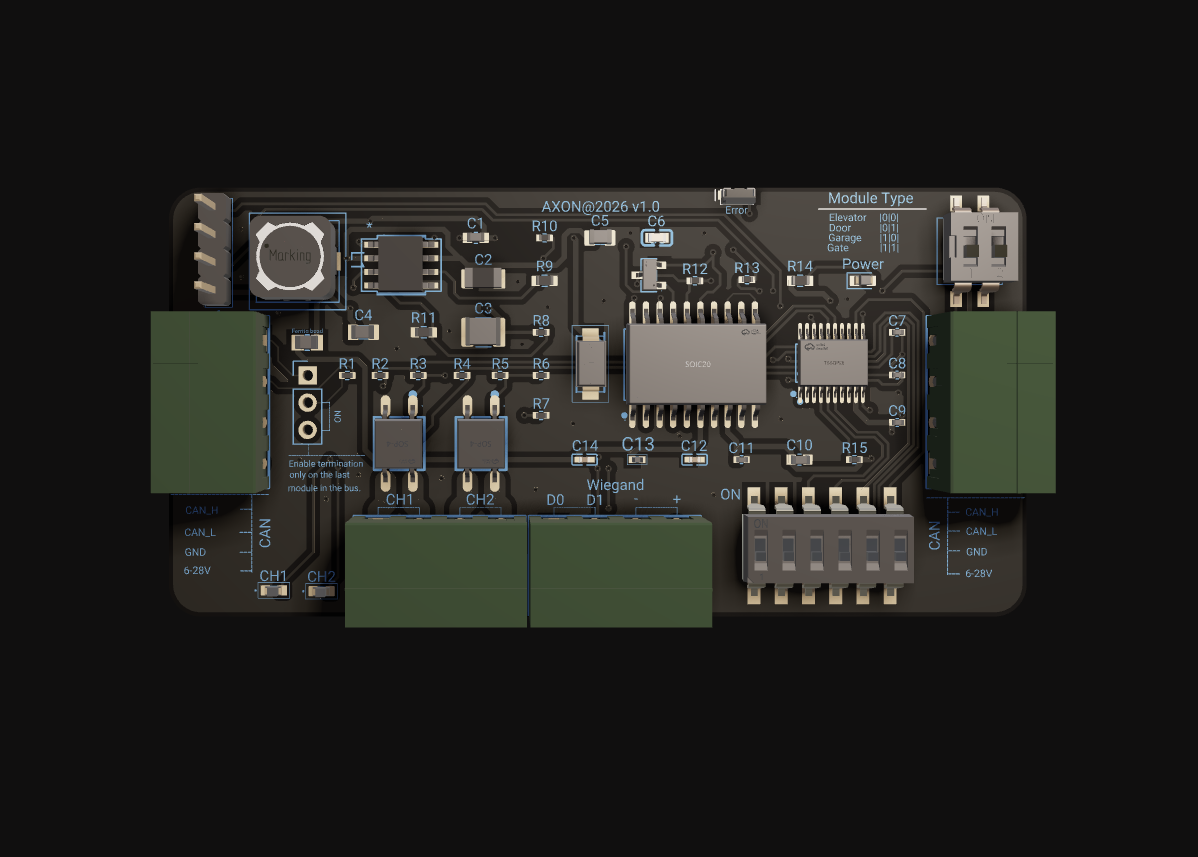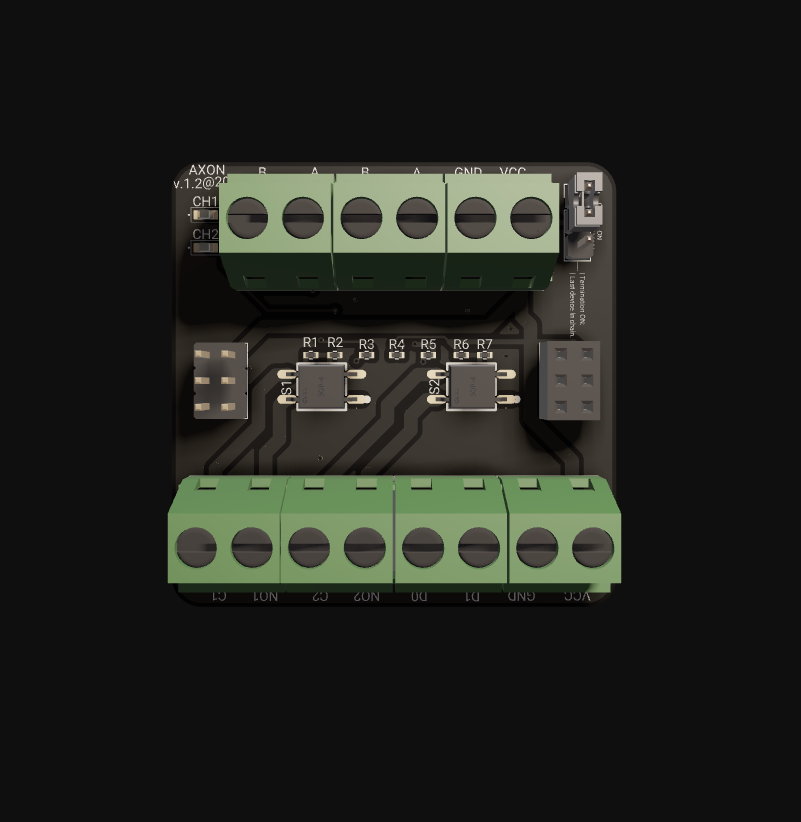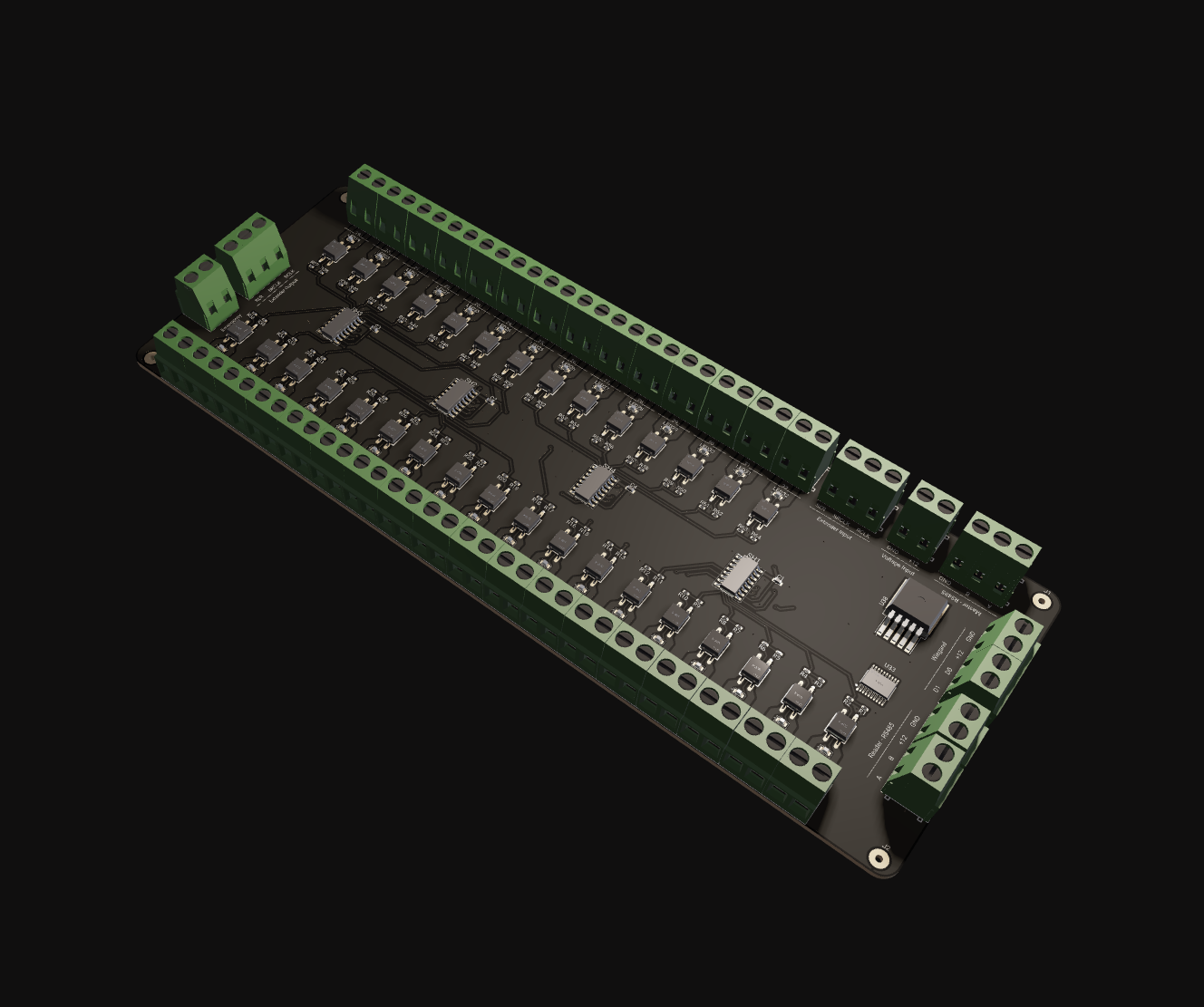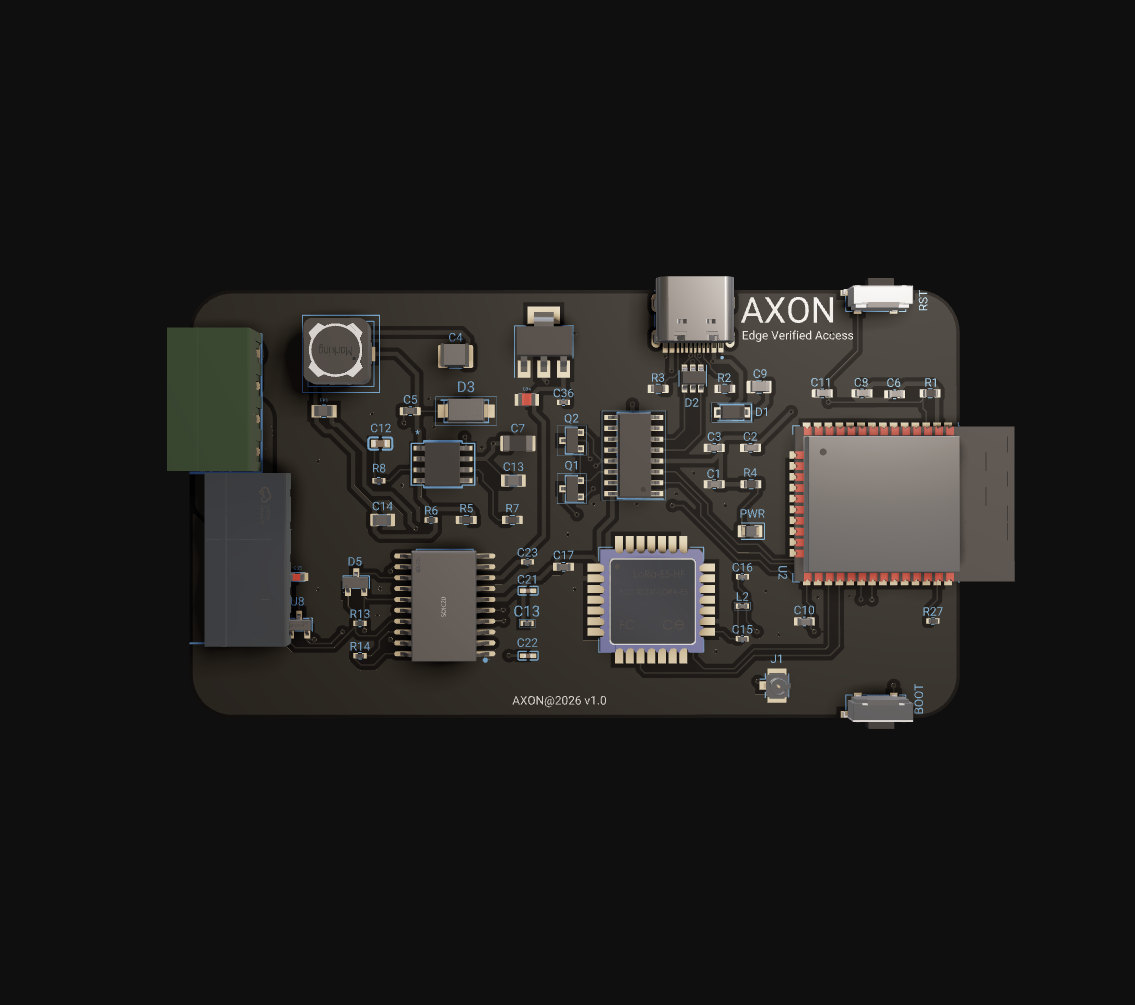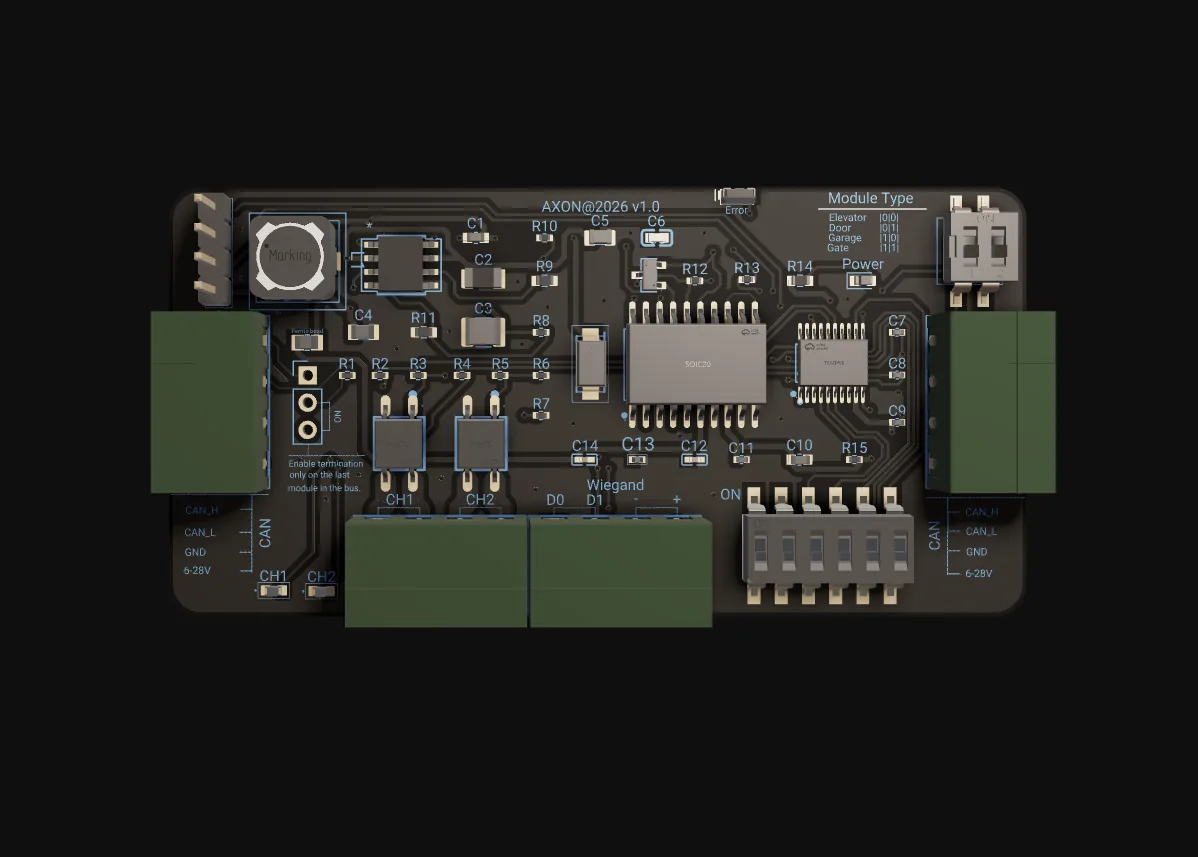
AXON RBN-2 is a dual-channel relay expansion node on the AXON RS-485 BUS. It carries two independent industrial NO/NC relays rated 5 A at 30 V DC, draws under 1 W at idle, and is individually addressable on the bus so the master controller can command each channel as a distinct logical endpoint. The two channels are logically isolated, so a fault on one does not disable the other — a property that matters when one module switches a door release and the other switches a light, gate, or zone alarm.
01 — What AXON RBN-2 Does in the System
AXON RBN-2 is an output-side expansion node in the AXON access control architecture. Where reader nodes capture credentials and the master controller decides authorization, RBN-2 sits at the end of the decision path: it receives commands over the RS-485 bus and switches a physical load — a door strike, a magnetic lock, a gate barrier relay, a corridor light, an alarm sounder, or a parking signal.
The "BN" in RBN-2 stands for Bus Node: this module belongs on a bus, not at the back of the controller cabinet. The point of putting relays on a bus is geographic — you want the relay close to the load it switches, not close to the brain. In a building with twenty access points, central wiring of every relay back to a panel produces heavy DC runs, voltage-drop problems, and an unfixable cable harness. With RBN-2 you run one twisted pair through the building, drop 12 V at each access point, and the relay sits within a metre of what it controls.
The "2" reflects the second design decision: two channels per board instead of one. This is deliberate. Many installations need to control two outputs at the same physical location — a door release plus a corridor light, a gate plus an alarm, two zones in the same room. Putting both on the same module saves a bus stub, a power tap, and an enclosure footprint, while keeping the channels logically isolated so a fault on one does not propagate to the other.
What RBN-2 does not do is just as important. It does not read cards. It does not authenticate users. It does not make access decisions. It executes the result of decisions taken upstream by the AXON master, and reports its own state back. Keeping the policy logic out of the output node is what makes large installs maintainable — when access rules change, they change in one place.
02 — Required Components
The RBN-2 board carries the following functional elements:
| Part | Role | Notes |
|---|---|---|
| MCU | Bus protocol + relay state machine | Handles RS-485 framing, addressing, and per-channel state. |
| RS-485 transceiver | Physical bus PHY | Half-duplex with direction control. |
| Industrial relay × 2 | Channel outputs | NO and NC contacts available per channel, rated 5 A @ 30 V DC. |
| Relay drivers | Coil drive + freewheel | Drives coils from logic level with reverse-EMF protection. |
| Per-channel terminal block | Load wiring | Separate terminals per channel keeps installation legible. |
| Power regulator | Board power | From 12 V DC input rail. |
| Addressing element | Bus address selection |
Why these specific parts
Industrial-grade electromechanical relays (per IEC 61810-1) were chosen over solid-state switching for this product because the target loads are heterogeneous: door strikes, magnetic locks, gate motor pilots, lights and sirens behave very differently electrically. An EMR has clean NO and NC contacts (per IEC 60947-5-1 control circuit switching), tolerates inductive load kickback with proper freewheeling, and provides true galvanic separation between the bus side and the load side, which solid-state alternatives do not. For high-density, high-cycle solid-state switching, the separate AXON SSR-32 is the right product; RBN-2 covers the case where two reliable, isolated, mixed-load contacts are what the install actually needs.
03 — How RBN-2 Works End-to-End
The operational flow is short, which is the point of an output node:
- Master decides. The AXON master receives a credential or schedule event, applies its permission rules, and decides that channel n on RBN-2 with bus address a should engage for a defined duration.
- Command transmitted on RS-485. The master sends an addressed command on the bus. Each RBN-2 reads the address and ignores frames not for it.
- State machine engages. The targeted channel's driver pulls in the relay coil. The NO contact closes and the NC contact opens (or vice versa, depending on which side of the contact form is wired to the load).
- Load energised. The local 12 V or 30 V DC load — strike, maglock, light, alarm — receives power across the contacts.
- Status reported. The RBN-2 reports actual channel state back on the bus so the master can supervise the result rather than assume it.
- Release. On the master's release command or expiry of the configured engagement window, the channel drops the relay and the load de-energises.
The two channels run this loop independently. A command targeting channel 1 does not touch channel 2's state machine; a fault on channel 2's driver does not block channel 1 from accepting and executing commands.
04 — Communication Architecture: RS-485 BUS
RS-485 (TIA-485-A) was the natural choice for an output expansion bus in this product class. It is a differential, multi-drop physical layer designed to run reliably across hundreds of metres of building cabling without active repeaters, on cheap, widely available twisted-pair cable. Every door, gate, light point or alarm device in a building is already at the end of some wire run — RS-485 lets the same physical topology carry the control signal that closes the relay near each of those endpoints.
Each RBN-2 has an individual address on the bus. The master targets a specific module and a specific channel within it. Multiple RBN-2 modules sit on the same bus segment without conflict: addressing is the responsibility of the installer at commissioning time, and it does not change in normal operation.
Why not direct controller I/O?
A common alternative — wiring every relay back to terminal blocks on the central controller — works in single-door installs but degrades rapidly with scale. Twenty doors means forty load wires converging on one cabinet, each carrying switched DC, each contributing voltage drop, and any change requires opening the cabinet. RS-485 makes the wiring local: load wires are short, the bus is long, and adding another relay later is a matter of T-ing onto an existing pair plus a local 12 V feed.
Why not Ethernet per relay node?
Putting an IP stack on every relay node would be technically possible but operationally heavy. It requires structured cabling to every output location, switches with enough ports, an addressing plan, and a security boundary at every node. For an output that only needs to receive "engage / release" commands, RS-485 with individual addressing carries the same information at a fraction of the wiring and infrastructure cost. Ethernet has a role at the master tier (ICM-GE, ELM-GE), not at the actuator tier.
05 — Interface Layout
| Function | Notes |
|---|---|
| RS-485 A / B | Differential bus pair, daisy-chain in and out where applicable. |
| BUS GND | Reference for the RS-485 transceiver; do not loop to the load ground. |
| VIN 12 V DC | Board supply. Keep local to the module's load location. |
| Channel 1 — COM / NO / NC | Relay 1 contacts. Wire COM to the load common; NO or NC selected by application. |
| Channel 2 — COM / NO / NC | Relay 2 contacts. Independent from channel 1. |
| Status indicator | Per-channel LED reflecting commanded state. |
Treat the bus side and the load side as electrically separate domains during installation: short load runs from the relay terminals to the strike/maglock/light, separate from the bus pair. Where the load is mains-driven (an AC corridor light circuit, for example), do not switch mains through the on-board relay — drive an external contactor sized for the AC load and switch the contactor coil with RBN-2.
06 — Security and Robustness
RBN-2 is an actuator, so its security model is about three things: who can command it, what happens when commands are lost or forged, and what physical state it presents under fault.
- Individual bus addressing. Commands are addressed, so a stray byte on the bus does not engage all relays.
- Logical channel isolation. Faults on one channel do not block bus traffic for the other channel, and they do not propagate to the second relay's state.
- Hold-on-loss behaviour. Default behaviour on loss of the master link is to hold last commanded state — not to release strikes opportunistically, which would create false unlocks during transient bus noise.
- Reverse-EMF protection. Each coil driver includes freewheel protection for inductive load switching.
- Bus-side / load-side separation. The relay contact form provides galvanic separation between the bus electronics and the switched load.
- Idle current discipline. Under 1 W at idle means many modules can share a small DIN-rail PSU without exotic heat dissipation budgets.
Open hardening areas. Bus-level message authentication (HMAC or similar) is a sensible next step for RBN-2 in mixed-tenancy buildings where a hostile party may gain physical access to a bus cable. Today, the security boundary is the bus cable plus the master. If you cannot guarantee the bus cable's physical integrity for the lifetime of the install, run it inside cable trunking that is locked or alarmed.
07 — Real-World Deployment Scenarios
Mid-rise residential entrance + corridor light (Prishtinë)
A residential building near Sheshi Skënderbeu in Prishtinë uses one RBN-2 at the main entrance: channel 1 drives the electric strike on the entrance door, channel 2 drives a contactor for the corridor light that the entrance reader should also activate on a valid card. When a resident presents a card, the master commands both channels; if the corridor lighting circuit fails (blown contactor, tripped breaker upstream), the entrance still opens — and vice versa.
Hotel back-of-house door + alarm (Tiranë)
A boutique hotel in Tiranë's Blloku area uses RBN-2 on the staff corridor that connects the lobby to the back-of-house: channel 1 holds an electric strike, channel 2 drives an alarm input on the front-desk panel. A staff card opens the door; an unauthorised attempt or door-forced-open event activates channel 2 to flag the front desk. One bus address, one PCB, two functions that must not share fate.
Parking lot gate + barrier light (Pejë)
An office parking lot in Pejë uses RBN-2 at the entry barrier: channel 1 pulses the barrier motor relay, channel 2 turns on a flashing barrier light while the arm is moving. The master coordinates both, the RBN-2 executes both, and a fault on the light circuit does not stop the gate from cycling for the next car.
Hospital ward door + nurse-station indicator (Mitrovicë)
A hospital ward in Mitrovicë uses RBN-2 to control a ward door (channel 1 — magnetic lock, energise-to-lock) and a nurse-station indicator light (channel 2). When the master de-energises the lock on a valid badge or emergency unlock event, the second channel switches the indicator on so staff at the desk see the door has been released. Logical isolation matters because the desk indicator and the door behave very differently electrically — one is a tiny DC LED panel feed, the other is a maglock coil.
08 — Installation Requirements
- Supply. 12 V DC, locally tapped at the module's installation point. Provide at least 10 W of headroom on each local PSU branch so the relays can pull in without dropping the rail.
- Bus cable. Shielded twisted pair for RS-485. Daisy-chain the bus through each module — do not star it from a central point.
- Termination. 120 Ω at both physical ends of the RS-485 segment, not at every module. Verify with a multimeter across A/B with all modules powered down — you should read about 60 Ω end-to-end.
- Load wiring. Keep load runs short — under 5 m from the channel terminal to the strike or maglock where possible. Long load runs amplify voltage drop and weaken pull-in margin.
- Mains loads. Never switch mains-voltage loads directly through the on-board contacts. Drive an external AC contactor and switch its coil instead.
- Enclosure. Standard IP30 indoor enclosure for lobby and corridor installs; IP65 with sealed cable entry for outdoor gate or barrier installs. Specify enclosures rated to UL94 V-0 flammability where required by local code.
- Separation from mains cables. Keep the RS-485 pair physically separated from mains-feed and motor-feed cables. Run them in different trays where possible.
09 — Recommended Bus Topology
RS-485 expects a linear, daisy-chained bus with short stubs:
- Straight backbone with short stubs. A single twisted pair runs through the building. Each RBN-2 connects via a stub of 30 cm or less. Terminate 120 Ω at the two physical ends only.
- Pure daisy chain. Each RBN-2 has bus-in and bus-out terminals; cable enters one and leaves the other. The first and the last module in the chain carry the termination resistors.
Common topology mistakes:
- Star topology. Running every module back to one central T-junction creates reflections that show up as sporadic, hard-to-reproduce frame loss.
- Termination at every module. Two terminators total — installing more drops bus impedance below specification and stresses every transceiver.
- Shared cable with mains. 50 Hz pickup and motor switching transients sit right in the bus's noise margin. Use separate trays.
- Local 12 V borrowed from a noisy supply. If the local 12 V tap also feeds a noisy load (a CCTV PoE injector, an LED dimmer), the relay drive can chatter on threshold.
10 — Troubleshooting Guide
One channel works, the other does not
This is almost always either a wiring fault on the failed channel's load terminal (loose conductor, broken strike coil) or a fault on the relay driver itself. Confirm by commanding the failed channel from the master and listening for the relay click on the board. If the relay engages but the load does not respond, the fault is downstream of the contacts. If there is no click, the fault is on the module — and because the channels are isolated, you can keep using the good channel while the module is swapped at the next convenience.
Both channels go offline together
Either the module has lost power (check the local 12 V tap and the supply LED) or it has lost the bus link (check the RS-485 cable continuity and termination). A whole-module dropout looks like an addressing or bus-physical fault, not a logic fault.
The relay engages but the load does not energise
You hear the click, the indicator LED is on, but the strike or light is dead. Inspect the load terminals: loose conductor, oxidised terminal, or a broken load downstream. On contact-form questions, confirm whether the load is wired across COM/NO or COM/NC — a fail-safe maglock on COM/NC will appear "dead" when the relay is engaged because the contact opens by design.
Intermittent engagement under load
Usually voltage-drop on the local 12 V rail. Coil pull-in needs the rail to stay clean; if a long thin wire feeds the module from a distant PSU, the inrush at relay engagement collapses the rail momentarily and the driver drops out. Shorten the supply run or upsize the conductor.
The bus master cannot see the module at all
Check addressing first: a duplicate address on the bus produces silence (both modules backing off arbitration) more often than a clean error. Then check the RS-485 wiring polarity (A and B reversed is a classic), then termination, then power. The "no module response at all" pattern is much more often an installation issue than a board fault.
11 — How AXON RBN-2 Compares to Alternatives
For builders evaluating output expansion options:
- Single-relay add-on modules. Cheap per module but doubled installation cost: each output needs its own bus stub, address, power tap, and enclosure footprint. RBN-2 collapses two functions into one PCB while preserving isolation.
- Generic Modbus relay boards (4/8/16 channel). High channel counts, but channel isolation is rarely a design goal — a fault on channel 3 often takes the whole board with it, and addressing is at module granularity, not channel granularity. RBN-2 is intentionally narrow at two channels because the operational case for "two outputs that must not share fate at the same physical location" is common enough to be its own product.
- PLC-style I/O modules. Powerful but expensive, oversized for an access install, and they require a PLC-class master to coordinate. RBN-2 fits the AXON master's command surface natively.
- Wired-back direct controller outputs. Lowest cost when there are one or two outputs, but the wiring economics flip badly as the install grows. RBN-2 on RS-485 is the right choice once the install has more than a handful of outputs spread across more than one room.
12 — Current Implementation Status
RBN-2 is a shipping module in stock at the time of writing.
What ships today
- Dual independent NO/NC relays rated 5 A @ 30 V DC.
- RS-485 BUS communication with individual addressing.
- Logical channel isolation between the two relays.
- 12 V DC supply, under 1 W idle consumption.
- Standard DIN-rail-compatible mounting form factor.
Areas marked for verification or roadmap
- Published AC switching rating on the on-board contacts. Today the published rating is DC; AC capability is intentionally not advertised.
- Bus-level message authentication (HMAC / signed command frames). Current security model relies on bus-cable integrity plus master authority.
- Contact-cycle lifetime under specific load classes (inductive vs resistive).
- Optional opto-isolation between bus-side and relay-driver logic for high-noise environments.
13 — Key Takeaways
- RBN-2 is an output expansion node — it acts on access decisions, it does not make them.
- Two channels per board, logically isolated, so a fault on one does not take the other down.
- RS-485 BUS with individual addressing keeps load wiring local and the bus wiring building-wide.
- Industrial NO/NC relay form supports mixed loads — strikes, maglocks, lights, alarms — on the same module.
- Under 1 W idle consumption keeps PSU sizing and enclosure heat budgets simple at scale.
14 — Frequently Asked Questions
Why does the RBN-2 use two independent relays instead of a single channel?
Because many access points actually need two outputs at the same place — door release plus light, gate plus alarm, two zones in the same room — and putting them on one PCB with shared bus, shared power and isolated channels saves install effort without compromising fault behaviour. Single-relay modules double the install cost without buying real safety.
What does "logical isolation between channels" actually mean?
If channel 1 develops a fault — welded contact, blown driver, shorted load — channel 2 still accepts commands and switches normally. The module reports the failed channel to the master but keeps the healthy channel running. Many cheaper multi-relay boards take the whole board offline on any channel fault; RBN-2 does not.
What loads can RBN-2 switch directly?
The published rating is 5 A at 30 V DC per channel — covering electric strikes, magnetic locks, gate motor pilots, DC lights, DC alarms. For AC mains loads, drive an external contactor sized for the load and switch its coil with RBN-2. AC switching ratings are not currently published for the on-board contacts.
How is each RBN-2 addressed on the bus?
Each module has an individual address on the RS-485 BUS, and the master targets a specific channel within a specific module. Several RBN-2 modules can share the same bus segment without conflict, as long as addresses are unique. Confirm addressing mechanism (DIP, rotary, or software-set) with the install guide for your unit.
What is the idle power consumption?
Under 1 W with no relay engaged. That matters at scale: twenty modules idle under 20 W steady state, which a small DIN-rail PSU handles comfortably. With relays engaged the figure rises with coil current — size your PSU for the realistic worst-case concurrent engage count.
Can the RBN-2 hold a relay engaged indefinitely?
Yes. Sustained engagement is supported for energise-to-lock maglocks and similar latched outputs. We still recommend a master-side timeout policy so a wedged state cannot trap a door indefinitely if the bus link is lost.
What happens if the RS-485 link to the master is lost?
The module holds the last commanded state by default. It does not autonomously decide to release a strike or fire an alarm, because that would create false events on every transient noise burst. The master should raise an offline-node alert when it stops seeing the module.
Why RS-485 instead of a controller with built-in I/O?
Because output wiring is shorter when the relay is next to the load, not next to the controller. RS-485 lets one twisted pair carry commands building-wide and the relays sit beside the door, gate or light they switch. The wiring economics dominate once you have more than a handful of outputs spread across multiple rooms.
Where does RBN-2 fit in the wider AXON architecture?
It is an actuator, not a brain. Pair it with reader-side nodes (AXON Node) and a master (ICM-GE for door/gate sites, ELM-GE for elevator sites). The master holds permissions; RBN-2 executes the resulting commands and reports state.
Can I mix RBN-2 with other AXON expansion modules on the same bus?
Yes — that is the design intent. RBN-2 shares the AXON RS-485 BUS with other expansion nodes. Plan the address space and keep total bus length within RS-485 limits with proper termination.
17 — References and Standards
- IEC 61810-1 (Electromechanical elementary relays — general and safety requirements)
- IEC 60947-5-1 (Low-voltage switchgear and controlgear — control circuit devices and switching elements)
- TIA-485-A (RS-485 differential multi-drop electrical interface)
- UL 94 (Tests for flammability of plastic materials — V-0 rating for enclosures)