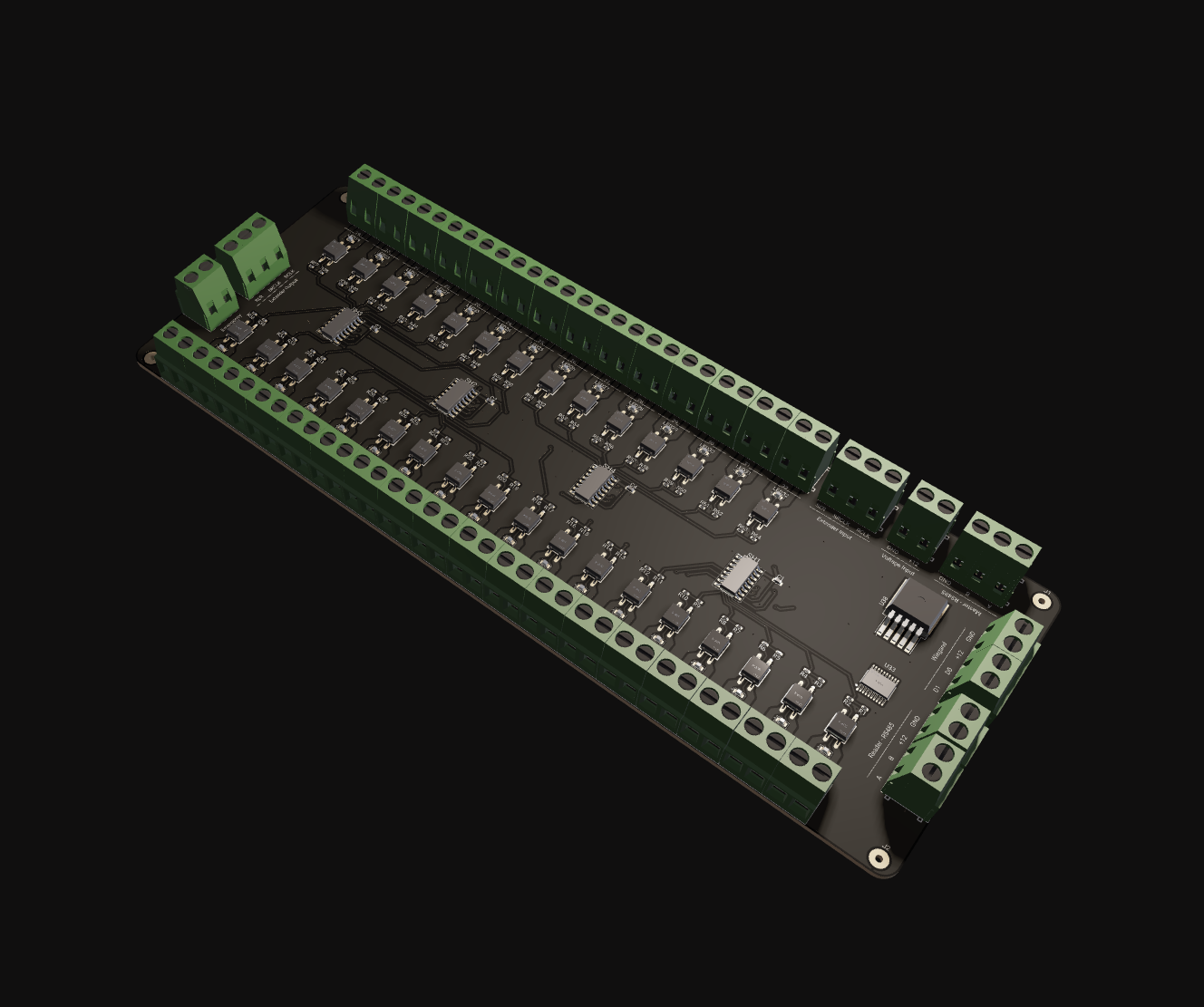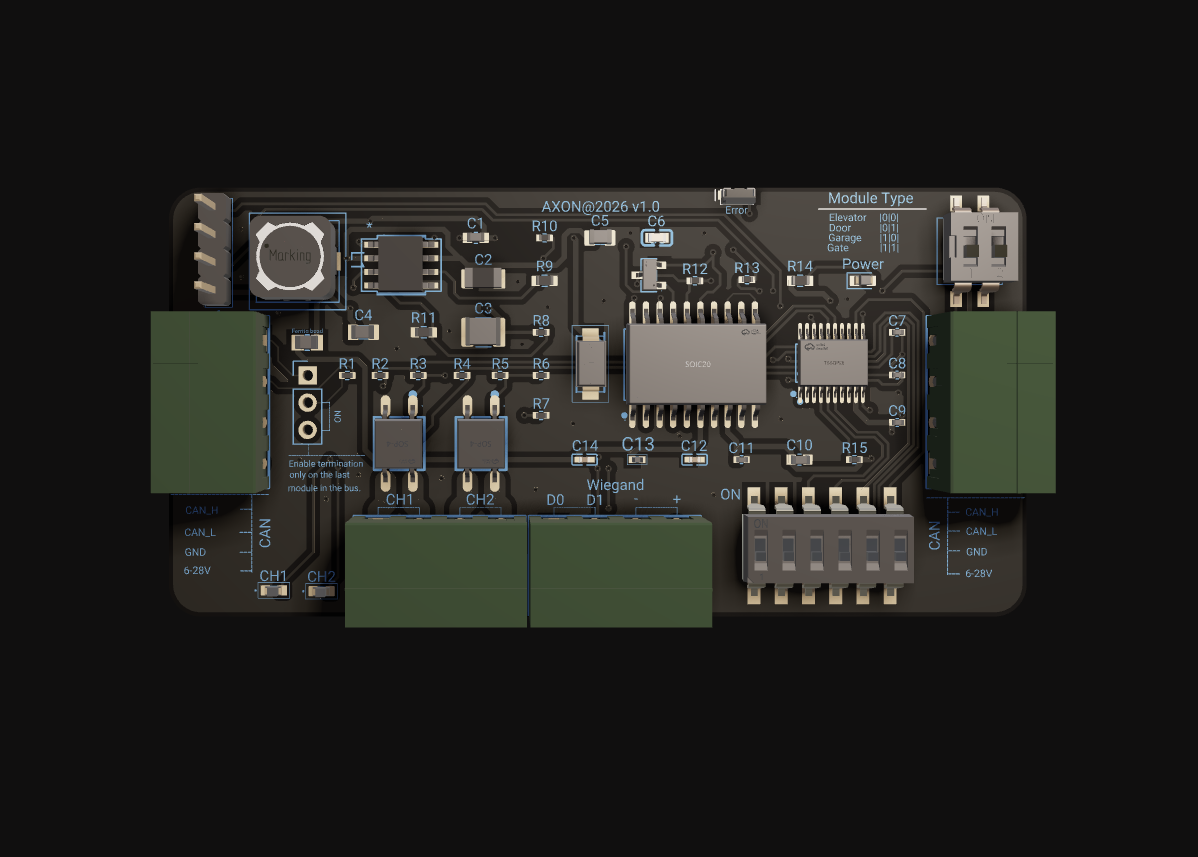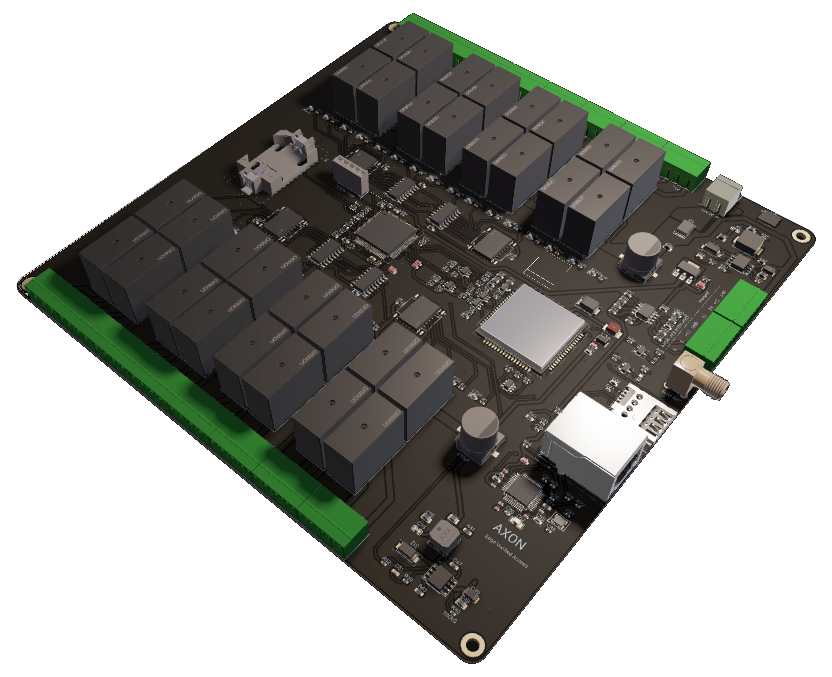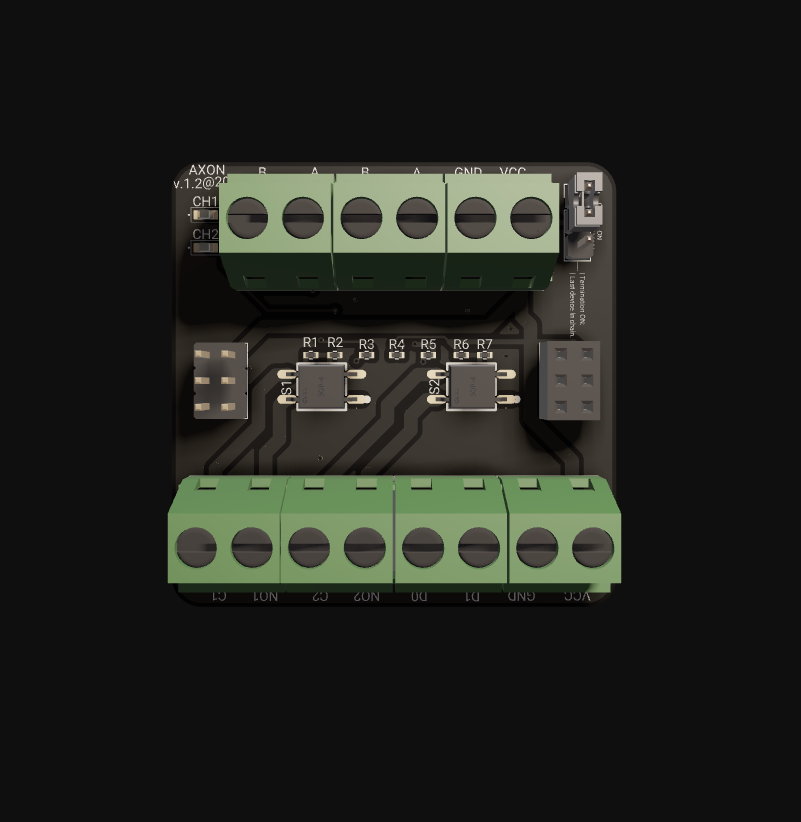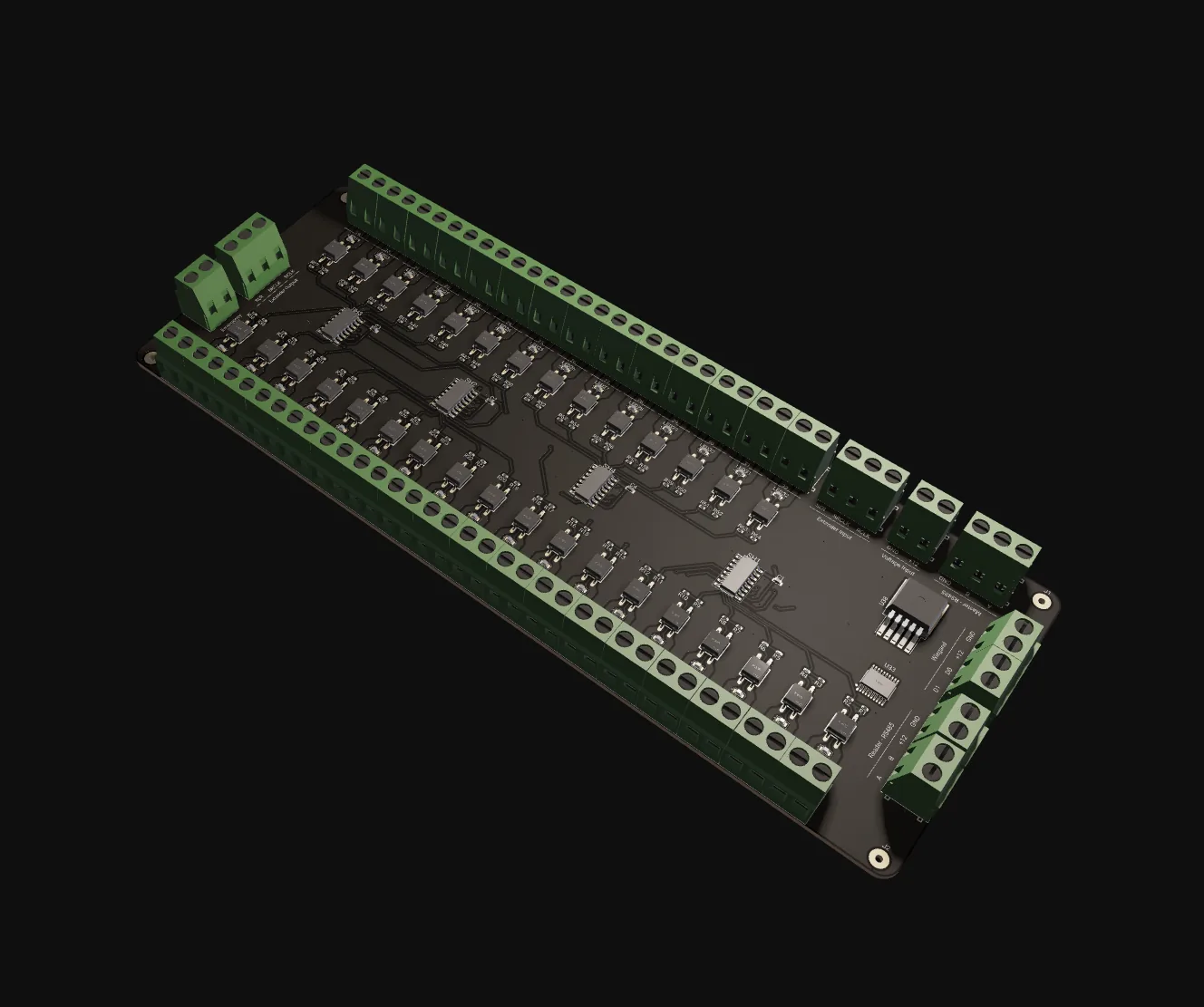
Development status. AXON SSR-32 is currently in development and not yet shipping as a stocked product. This page describes design intent, target capabilities, and where the board fits in the AXON architecture. Final per-channel electrical ratings, AC/DC switching support, thermal derating curves and pricing will be published as the product completes validation. For pilot integrations on planned installs, contact AXON directly.
AXON SSR-32 is a 32-channel solid-state relay expansion board on the AXON RS-485 BUS. It uses solid-state switching elements rather than electromechanical contacts, supports both per-channel and group commands, accepts 12 V or 24 V DC supply, and is intended for high-density, high-cycle, low-maintenance output applications across access control and adjacent automation. The product is currently in development; this page captures the design intent and the role it plays alongside RBN-2 (industrial EMR) and CCU-32 (cabin master).
01 — What AXON SSR-32 Does in the System
AXON SSR-32 is a high-density output expansion node intended for the AXON access control and automation architecture. Its job is to convert addressed bus commands from the AXON master into electrical switching actions across up to thirty-two independent outputs. Where RBN-2 covers the two-channel "right next to the load" case with industrial electromechanical contacts, SSR-32 covers the opposite end of the output spectrum: many channels in one cabinet, switching frequently, for years, without contact wear.
The decision to use solid-state switching elements (per IEC 62314) rather than electromechanical relays is a deliberate trade-off. Solid-state devices have effectively unlimited mechanical cycle life — there is no moving armature to fatigue, no contacts to pit, no spring to lose tension. In return, they have a non-zero on-state voltage drop, dissipate heat proportional to channel current, and require attention to inrush, dV/dt and transient suppression. For access control outputs that switch tens of thousands of times per year over a ten-year install life, the EMR contact-wear arithmetic becomes uncomfortable; solid-state switching makes the wear problem disappear and replaces it with a thermal-and-protection problem, which is easier to engineer once and forget.
SSR-32 belongs in centralised output cabinets — control rooms, machine rooms, IT closets — where a single board can switch many local loads. The classic use cases include elevator floor authorisation outputs, dense parking-lot signalling, hotel back-of-house lighting and zone control, and large-building corridor or zone alarm signalling. In every case the master holds the access rules; SSR-32 executes the result.
Like every AXON expansion node, SSR-32 does not authenticate users, does not read cards, and does not hold access policy. It receives addressed commands, switches channels, reports state. The policy logic stays at the master tier where it can be updated centrally without touching any output board.
02 — Required Components
The SSR-32 board carries the following functional blocks (final BOM is part of the in-development validation cycle):
| Part | Role | Notes |
|---|---|---|
| MCU | Bus protocol + 32-channel state machine | Handles RS-485 framing, addressing, per-channel and group command parsing. |
| RS-485 transceiver | Physical bus PHY | Half-duplex with direction control. |
| Solid-state switching elements × 32 | Channel outputs | No mechanical contacts. |
| Gate drivers | Logic-to-power interface | Drives the switching elements from logic level. |
| Per-channel optical isolation | Bus-side / load-side separation | |
| Per-channel terminal block | Load wiring | 32 channels — terminal density and labelling are critical for serviceability. |
| Power regulator | Board power | Accepts 12 V or 24 V DC input. |
| Thermal management | Heat dissipation | Heatsink area and board copper sized for realistic concurrent engagement. |
| Addressing element | Bus address selection |
Why these specific parts
Solid-state switching was chosen because the target deployments cycle channels often enough that EMR contact life becomes the maintenance bottleneck. RS-485 was chosen because it is the same physical layer as the rest of the AXON bus family — one transceiver type, one termination discipline, one set of tools the installer already knows. The MCU is sized for thirty-two-channel state plus group-command parsing without being expensive. Per-channel optical isolation (per IEC 60747-5-5 for optoelectronic devices) is the intended separation strategy between bus electronics and the switched load domains, because high-density switching otherwise becomes a noise-coupling problem on the bus side.
03 — How SSR-32 Works End-to-End
- Master decides. The AXON master applies its permission rules — credential, schedule, lockdown state, group policy — and resolves which output channels need to engage and for how long.
- Command transmitted on RS-485. The master sends an addressed command. Per-channel commands carry channel index and duration; group commands carry a group identifier mapped to a configured set of channels on the SSR-32.
- Frame parsed. SSR-32 reads its address, parses the command type, and resolves the affected channel set.
- Channels engaged. The gate drivers turn on the targeted solid-state elements. Engagement is fast — microseconds for the switching event itself.
- Loads energised. The local DC (and, where supported, AC) loads receive power through the on-state SSRs.
- State reported. SSR-32 reports actual channel state back to the master so the master can supervise, not assume.
- Release. On the master's release command or expiry of the configured duration, the channel set turns off.
Group commands compress the worst case: a fire-alarm-triggered emergency unlock, a scheduled scene change, or a coordinated zone signal becomes one bus message rather than thirty-two. That reduces bus airtime, removes "racing" between channels, and makes coordinated events atomic from the master's perspective.
04 — Communication Architecture: RS-485 BUS
SSR-32 sits on the same AXON RS-485 BUS (TIA-485-A) as RBN-2 relay nodes, reader nodes, and the master tier. Each board has its own bus address; the master targets a board and then a channel or group within it.
Why RS-485 for a 32-channel actuator
The alternative would be parallel I/O ribbon from a controller to the SSR board, or Ethernet per output board. Parallel I/O does not scale beyond one cabinet — each output board would need a wide ribbon back to the master. Ethernet per output board adds switch ports, IP plan, and per-board security surface for what is fundamentally a "set channel state" command. RS-485 with addressed framing carries that command efficiently on a single twisted pair with simple termination — the same physical layer the rest of the AXON bus already uses.
Why per-channel and group commands together
Per-channel commands are the common case: one credential causes one floor to authorise, one door to release, one zone to signal. Group commands handle the coordinated cases: cascade unlock on fire alarm, lighting scene change at end-of-day, multi-floor authorisation for a service card. Supporting both on the same module avoids forcing the master to fan out a group into thirty-two separate frames, which would otherwise dominate bus airtime during peak events.
Bus framing and addressing
The exact bus framing layout (frame format, CRC, group address space) is part of the in-development specification. The shape is similar to other AXON RS-485 expansion nodes: addressed frames, parsed by the targeted board, with the rest of the bus ignoring traffic not for them.
05 — Interface Layout (Target)
| Function | Notes |
|---|---|
| RS-485 A / B | Differential bus pair; daisy-chain in and out. |
| BUS GND | Reference for the RS-485 transceiver. |
| VIN 12 V / 24 V DC | Board supply; input voltage detected or selected per unit configuration. |
| Channels 1–32 — A / B terminals per channel | SSR output pair per channel; load wiring across the pair. |
| Status indicators | Per-channel LED reflecting commanded state. |
| Heatsink area | Allow airflow above the board in the enclosure. |
Terminal density on a 32-channel board is a real installation problem. Pre-plan the labelling at commissioning: bring a printed channel map with the master's logical labels mapped to physical terminal positions, and laminate it inside the cabinet door. Six months later, when someone has to swap a strike on channel 19, they will be glad.
06 — Security and Robustness
- Individual bus addressing. Stray bus bytes do not engage outputs.
- Group address discipline. Group definitions are configured at commissioning, so the master sends short safe commands rather than open-ended channel masks.
- Per-channel optical isolation (target). Bus-side electronics protected from load-side transients.
- Hold-on-loss behaviour. Default behaviour on loss of the master link is to hold last commanded state, not to autonomously release or trigger.
- Solid-state cycle life. No mechanical wear on the switching elements; failures, when they occur, are thermal or transient-driven rather than wear-driven.
- Bus framing integrity. CRC-protected frames so corrupted commands are dropped rather than partially executed.
Open hardening areas (in development). Bus-level message authentication, transient voltage protection schedules per channel class, and channel-level current sensing for over-current shutoff are areas under active design. Final hardening profile will be published with the production release.
07 — Real-World Deployment Scenarios
High-rise elevator floor authorisation (Prishtinë)
A new high-rise residential project near Lakrishte in Prishtinë needs floor-level access authorisation across thirty floors. SSR-32 sits in the elevator machine room, each channel mapped to a floor authorisation output to the elevator controller. The AXON master holds floor-to-credential mappings; on a valid badge, the master sends a group command authorising the resident's specific floor — one bus message, one switching event, one floor authorised. Solid-state lifetime matters because elevator authorisation cycles thousands of times per month across a building.
Hotel back-of-house corridor lighting and zone control (Tiranë)
A hotel in central Tiranë uses SSR-32 in the back-of-house control cabinet to switch thirty-two zones — corridors, service rooms, back-of-house light circuits — based on a combination of staff card events and time-of-day schedules. Group commands handle scene changes; per-channel commands handle individual staff events. EMR boards would need contact-life budgeting for this duty cycle; SSR-32 does not.
Multi-bay parking facility signalling (Pejë)
A parking facility in Pejë has thirty-two parking bays with per-bay availability lights and gate signals. SSR-32 sits in the parking control cabinet, switching the per-bay outputs as cars arrive and leave according to occupancy events from the AXON master. Per-channel commands cover individual bay state changes; group commands handle batch updates at shift changes or facility-wide events.
Hospital ward zone signalling (Mitrovicë)
A hospital ward in Mitrovicë uses SSR-32 to drive a matrix of nurse-station indicator lights and door state signals across multiple wings. Each channel is one indicator; group commands handle wing-wide or shift-wide changes. Silent solid-state switching also matters in a clinical environment where mechanical relay chatter is undesirable.
08 — Installation Requirements
- Supply. 12 V DC or 24 V DC, sized for the realistic worst-case concurrent channel engagement, not for nominal-quiet operation.
- Bus cable. Shielded twisted pair RS-485, daisy-chained through the cabinet.
- Termination. 120 Ω at the two physical ends of the bus only.
- Mounting orientation. Allow airflow around the heatsink area. Vertical mounting in a ventilated cabinet is typically preferred for thermal performance.
- Channel labelling. Pre-printed channel map kept inside the cabinet door — non-negotiable on a 32-channel board.
- Load wiring discipline. Each channel pair is its own load loop. Do not daisy-chain load grounds across unrelated channels; doing so propagates load-side noise across the board.
- Transient suppression. Inductive loads (gate coils, contactor coils) need their own snubbers external to the board. Solid-state outputs tolerate this badly when neglected.
- Mains loads. Until AC switching ratings are published, treat the board as DC-output and drive AC contactors externally.
09 — Recommended Topology and Wiring Discipline
RS-485 topology is identical to the rest of the AXON bus family — linear backbone, short stubs, 120 Ω termination at the two physical ends. What is different for SSR-32 is the load-side wiring discipline, because thirty-two channels concentrated on one board create a dense, fault-prone wiring loom if treated casually.
- Pre-plan the load loom. Bring loads in by channel block (channels 1–8, 9–16, 17–24, 25–32). Each block has its own cable trunking compartment if the load count justifies it.
- One load per channel pair. Do not multi-drop loads off a single channel without explicit current and lifetime budget. Channel ratings are per channel, not per loom.
- Keep load grounds segregated. Particularly for noisy inductive loads — a shared load ground between a clean indicator channel and a noisy contactor coil channel will couple noise into the clean channel.
- Label both ends of every load wire. Channel number, logical name, and date of install. Use heat-shrink labels, not adhesive tags that fall off in three years.
- Document the channel map in the cabinet. Print, laminate, hang inside the door. Six months later your future self will thank you.
- Provide spare-channel discipline. Reserve at least two channels untouched on every install for future additions; without that discipline, the next change request becomes a full re-cable.
10 — Troubleshooting Guide
A single channel never switches
Confirm the master is actually addressing the channel (bus capture or master log). If the command reaches the board, check the per-channel status indicator — if it lights but the load does not energise, the fault is downstream of the channel terminals. If the indicator does not light, the channel itself may be faulted; an SSR failure typically presents as "stuck off" or "stuck on" rather than intermittent.
A single channel is stuck "on"
Common solid-state failure mode: the switching element has failed short. The other 31 channels are usually unaffected. Isolate the failed channel's load, document the failure, and schedule a board swap at convenience. Until the board is replaced, the affected load is energised; provide a mechanical interlock or local disconnect downstream of the channel for safety-critical loads.
Multiple channels behave erratically together
Almost always a power-supply or thermal issue. Check the 12 V / 24 V rail at the board terminal under load — voltage dip across the supply run starves the gate drivers and makes channels chatter. Check that the cabinet is not running hot — sustained high concurrent engagement can derate the board if airflow is constrained.
Bus loses the board entirely
Address collision, polarity reversal, or termination fault, in that order of likelihood. Confirm the address is unique on the segment, confirm A/B polarity, then measure termination resistance with the bus powered down.
Group command engages the wrong channels
Group definitions are configured at the board; a mismatch between master expectation and board configuration causes the wrong channel set to actuate. Re-export the group definition from the master and compare with the board configuration. Treat group configuration as commissioning data that travels with the install documentation.
11 — How SSR-32 Compares to Alternatives
- Mechanical relay boards (8/16/32 channel). Cheaper per channel, well-known electrical behaviour, but finite contact life. For high-cycle applications they become a scheduled-maintenance problem. SSR-32 trades contact life for thermal design and is the right call when cycle count over a 10-year install life is the dominant cost factor.
- Industrial PLC I/O modules. Maximum flexibility but oversized for access control. PLC I/O assumes a PLC master and a PLC engineering toolchain; SSR-32 plugs into the AXON master tier directly with no extra layer.
- Direct controller outputs. Adequate for a handful of channels per cabinet. Beyond about a dozen outputs in one cabinet, the wiring loom and the controller's physical real estate dominate, and a dedicated expansion board is the right answer.
- Generic Modbus SSR boards. Available off-the-shelf but rarely designed with access-control behavioural expectations — hold-on-loss, supervised state reporting, group command semantics. SSR-32 inherits those behaviours from the AXON BUS conventions.
- AXON RBN-2 (the sibling product). When the install only needs two channels at one location with electromechanical contact form and galvanic separation, RBN-2 is the cheaper and simpler answer. When the install needs many channels in one cabinet at high duty cycle, SSR-32 is the right answer.
12 — Current Implementation Status
To set integrator expectations honestly:
Current status: in development
- Design intent and architectural role are stable: 32-channel solid-state expansion on RS-485 BUS, per-channel and group commands, 12 V / 24 V DC supply.
- Final per-channel electrical ratings, AC vs DC switching capability, and thermal derating curves are being finalised in the validation cycle.
- Pilot integrations on planned installs are possible by direct arrangement with AXON.
- Production availability, pricing, and lead times will be published when the product moves out of development.
Confirmed at this stage
- 32 solid-state channels (no mechanical contacts).
- RS-485 BUS communication.
- Per-channel and group command modes.
- 12 V DC and 24 V DC supply options.
- Designed to share the AXON BUS with RBN-2, reader nodes, and the master tier (ICM-GE / ELM-GE).
Not yet finalised (do not specify in tender documents)
- Per-channel current rating and AC mains switching capability.
- Thermal derating curve under sustained concurrent engagement.
- Per-channel isolation voltage and transient suppression scheme.
- Bus-level authentication of commands.
- Production cost per channel.
13 — Key Takeaways
- SSR-32 is high-density, solid-state output expansion for the AXON BUS — chosen when cycle life and switching speed dominate the design.
- Thirty-two channels per board, per-channel and group commands, on RS-485 — efficient for cascade events.
- No mechanical contacts means no contact-wear maintenance — replaced by thermal-and-protection engineering.
- Sits between RBN-2 (two channels EMR) and CCU-32 (cabin master) in the AXON output product family.
- Status is in development; pilot integrations possible by direct arrangement.
14 — Frequently Asked Questions
What is the AXON SSR-32 and when is it shipping?
A 32-channel solid-state relay expansion board for the AXON BUS, currently in development. Final electrical ratings, AC/DC capability and pricing will be published with the production release. For pilot use on a planned install, contact AXON directly.
Why solid-state instead of mechanical relays?
Solid-state switching has effectively unlimited mechanical cycle life, switches in microseconds, is silent, and needs no contact-wear maintenance. The trade-off is non-zero on-state voltage drop, thermal dissipation under load, and care with inrush and transients. For high-cycle access control outputs, the lifetime arithmetic strongly favours SSR.
What is the difference between per-channel and group commands?
Per-channel commands target one of the 32 outputs individually. Group commands target a configured set of channels in one bus message — useful for cascade unlock, lighting scenes, or coordinated zone events. Both modes are supported on the same board so the master sends short safe commands instead of fanning out.
Why 12 V and 24 V DC supply options?
12 V matches the rest of the AXON family; 24 V is the standard control DC in industrial and elevator-room cabinets. Supporting both lets the SSR-32 drop in to either environment without an external converter.
Where does SSR-32 fit relative to RBN-2 and CCU-32?
RBN-2 covers the two-channel case with electromechanical contacts close to the load. CCU-32 is the cabin master with 32 outputs for elevator floor authorisation. SSR-32 is the centralised, high-density, solid-state option for cabinets that need many channels at high duty cycle.
Can SSR-32 switch AC mains loads?
SSR topology dictates AC vs DC capability. The final SSR-32 ratings will say which load classes are supported and at what current. Until then, treat the board as DC-output and drive AC contactors externally for mains switching.
How is heat managed with many channels active?
Heat dissipation is proportional to per-channel current and the on-state voltage drop. The board is designed for realistic worst-case concurrent engagement, which is much less than thirty-two channels at full load simultaneously. Final thermal derating curves will be published with production release.
How does the SSR-32 sit on the AXON BUS with other modules?
It shares the same RS-485 BUS as reader nodes, RBN-2 boards, and the master tier. Each SSR-32 has a unique bus address; the master targets a board and then a channel or group within it. Plan the address space so SSR-32 sits alongside other expansion modules without collision.
What is the maintenance profile?
Effectively zero scheduled maintenance under the thermal envelope. Inspect terminal torque, heatsinking and airflow. Failures, when they occur, are usually load-driven (over-current, transient, thermal) rather than wear-driven.
Can I specify SSR-32 in a tender today?
Specify the architectural role (32-channel solid-state expansion on AXON BUS) but do not pin specific per-channel electrical ratings until the production datasheet is published. For active tenders on planned installs, contact AXON for the latest validation status and an integration commitment.
17 — References and Standards
- IEC 62314 (Solid-state relays — general requirements)
- TIA-485-A (RS-485 differential multi-drop electrical interface)
- IEC 60747-5-5 (Semiconductor devices — discrete devices — Part 5-5: Optoelectronic devices / photocouplers)