AXON Smart Touch
A landing, cabin or entrance panel that combines a capacitive touch face, an RFID antenna and a fingerprint sensor, so one device authenticates the user and reports one encrypted event to the AXON Master.
One panel, one authenticated event
AXON SBT-TRF replaces the conventional landing button, intercom call surface or door access button with a single panel that knows who is asking for access and how strongly they have proven it. Physically it is one assembly: a capacitive touch face, an RFID antenna area co-located with it, and a biometric fingerprint sensor. Functionally it runs three authentication paths — RFID alone, fingerprint alone, or both within a configurable window — and produces one authenticated event on the encrypted AXON BUS. Mode is a per-panel configuration, not a hardware variant, so most landings can run RFID-only while a few restricted floors require multi-factor.
The panel authenticates and reports; it does not decide. The AXON Master holds the permission policy, time windows, lockdown state and the audit log, exactly as it does for the rest of the AXON family. That split means a card revoked centrally is refused at every SBT-TRF panel on the next presentation with no per-device update, and a temporary lockdown of staff floors is one Master-side change. On the bus the panel is one addressable node even though it has three input modalities, so the Master sees a single atomic event instead of reassembling fragments from separate readers.
What crosses the bus is minimal by design. The panel emits the device address, a credential identifier, the factor combination used and a timestamp, encrypted before transmission. The raw fingerprint image and the raw RFID exchange never leave the panel; templates are matched locally and the image is not stored persistently. There is no diagnostic plaintext mode in production firmware, so a passive listener on the bus sees ciphertext only — a Wiegand-style tap-and-replay attack has no plaintext stage to land on. The board is in active development: role, modes and bus integration are confirmed, hardware-level values are being finalised.
What the board does for the site
Smart-command touch face
The touch surface replaces the mechanical button. Capacitive sensing is designed to the EMC immunity requirements of IEC 61326-3-1, and the smart-command layer handles long-press, gesture and floor-selection logic. A status indicator shows which factor is being requested and whether authentication succeeded.
RFID path for everyday access
The fast contactless path for known cards, aligned with the ISO/IEC 14443 proximity-card standard used by most building credentials in the region. This is the typical residential flow: present the card, the panel emits the event, and the Master applies the tenant-to-floor mapping and time window.
Fingerprint matched on the panel
The biometric path binds the credential to a person rather than to a card that can be lost, shared or cloned. Templates follow the ISO/IEC 19794-2 minutiae format and are matched locally. The raw image is not transmitted on the bus and is not stored persistently in normal operation.
Multi-factor enforced in the panel
In multi-factor mode both RFID and fingerprint must succeed within a configurable window, and the panel itself enforces it. The Master receives one multi-factor event, not two single-factor events close in time, and rejects single-factor events from panels configured for multi-factor. This lines up with AAL2 in NIST SP 800-63B.
Encrypted bus, no plaintext stage
Frames are encrypted before they reach the AXON BUS, so a passive listener sees ciphertext only. There is no diagnostic plaintext mode to trip the panel into. Crypto parameters, anti-replay model and key management follow the rest of the AXON family; that parity work is being finalised for release.
Fail-closed by default
If the Master becomes unreachable, the recommended default for SBT-TRF-protected access points is to deny. Briefly refusing access in a restricted building is preferable to inadvertently allowing it. The failure policy is configurable per channel because some cases, such as a fire-mode override, must fail open under safety regulation.
From touch to elevator command
Wake and capture
The touch face activates and indicates the required factors. The user presents a card, places a finger on the sensor, or does both within the configured window.
Local authentication
The panel matches the RFID identifier against its configured set and the fingerprint against the locally stored template. Only the match result and credential identifier go downstream.
Encrypted frame to Master
Device address, credential identifier, factor combination and timestamp are encoded as an AXON BUS message, encrypted, and transmitted to the AXON Master.
Master decides and commands
The Master checks the event against permission policy, time windows and lockdown state, then issues the elevator command — call cabin, allow floor, or log denial — over the bus.
One addressable node on the encrypted AXON BUS
Encrypted AXON BUS over RS-485
The panel talks to the AXON Master over the same encrypted backbone used by other AXON modules — an encrypted differential pair on a dedicated twisted pair back to the riser. Frames are encrypted before transmission, which removes the plaintext reader-to-controller interconnect that legacy Wiegand installs expose to tap-and-replay attacks.
RS-485 · encrypted · terminated endsOne node, three modalities
Even with touch, RFID and fingerprint on board, the panel appears on the bus as one addressable node and emits one authenticated event per attempt. Splitting the modalities into separate nodes would force the Master to reassemble an atomic action and invite races on which modality completed first. Each panel needs a unique bus address.
Unique address per panelWhat never leaves the panel
The Master sees the credential identifier and the factor combination — never the raw fingerprint image or the raw RFID exchange. Keeping on-bus data minimal reduces the blast radius of any future bus-level vulnerability and keeps the audit log single-sourced: who authenticated, where, when and how, from one node.
Credential ID + factor combination onlyThe numbers, from the datasheet
Confirmed design values from the current development cycle. Fingerprint sensor model, RFID credential format, supply voltage, current draw, environmental rating and panel dimensions are being finalised and are not listed.
| Role | Smart access panel — authenticates and reports |
|---|---|
| Interface | Capacitive touch face with smart-command logic |
| Authentication modes | RFID · Fingerprint · Multi-factor (RFID + fingerprint) |
| Decision authority | AXON Master — policy, time windows, lockdown, audit |
| Bus presence | One addressable node, one event per attempt |
| Status | In development — field pilots before general availability |
| RFID | Contactless, aligned with ISO/IEC 14443 proximity cards |
|---|---|
| Fingerprint | Local template match; ISO/IEC 19794-2 minutiae format |
| Multi-factor window | Configurable; enforced in the panel |
| Raw biometric data | Never transmitted; not stored persistently |
| Enrollment (design intent) | Master-managed, templates stored on the panel |
| Assurance alignment | NIST SP 800-63B AAL2 for multi-factor |
| Bus | Encrypted AXON BUS, RS-485 |
|---|---|
| Physical link | Differential pair on a dedicated twisted pair |
| Topology | Linear with short stubs; terminate both physical ends only |
| Addressing | Unique bus address per panel |
| Routing | Keep away from mains and motor cabling |
| Bus encryption | Always on — no diagnostic plaintext mode in production |
|---|---|
| Crypto posture | Parity with AXON family: encryption, anti-replay, keys |
| Failure policy | Fail-closed default; configurable per channel |
| Multi-factor enforcement | In-panel; single-factor events rejected on MF panels |
| Roadmap | Per-device keys via secure element (planned) |
| Touch face | Capacitive; IEC 61326-3-1 EMC immunity design target |
|---|---|
| Status indicator | Requested factor + authentication result |
| Antenna / sensor placement | Avoid metal trim, direct sunlight, moisture |
| Mounting | Landings, cabin walls, building entrances, controlled doors |
| Power | Local DC supply per panel |
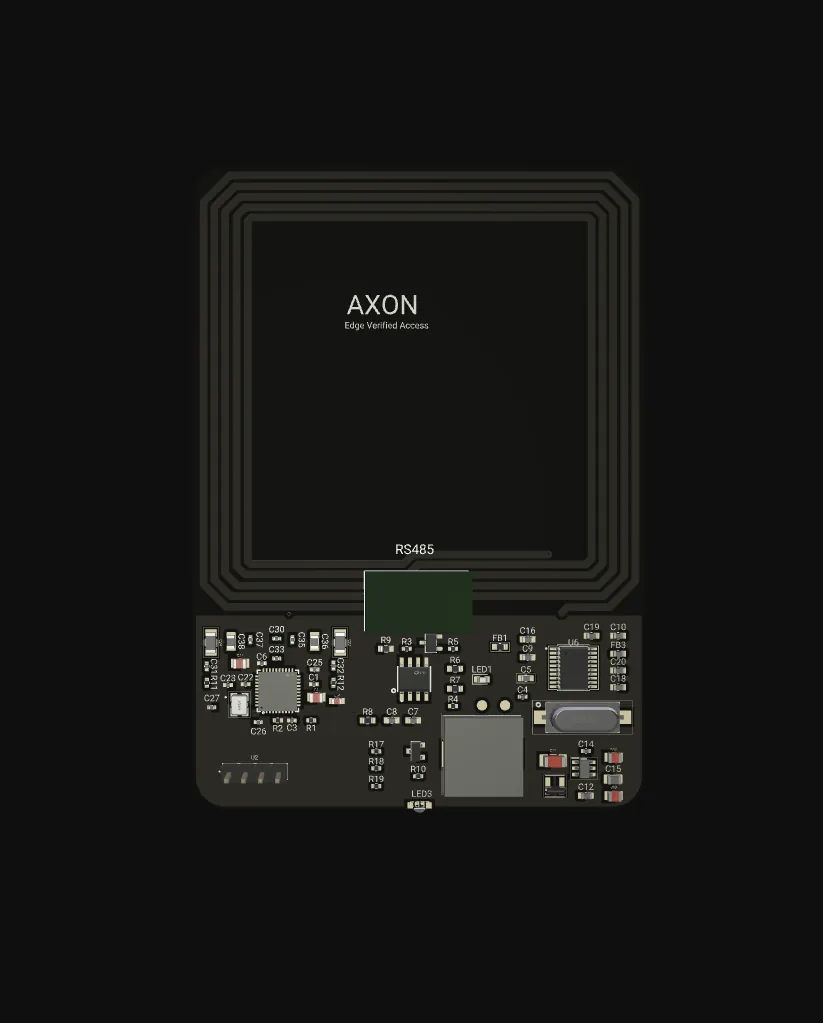
Interface layout (being finalised)
Capacitive smart-command surface replacing the mechanical button; long-press, gesture and floor-selection logic.
Co-located with the touch face so card and touch are a single presentation gesture. Do not mount behind metal trim.
Biometric capture with local matching; the raw image never leaves the panel.
Encrypted differential pair to the AXON backbone; dedicated twisted pair, unique address per panel.
Local DC supply at the panel location; voltage and current are confirmed at release.
Shows which factor is being requested and whether authentication succeeded.
How it compares to split-device designs
| Aspect | AXON SBT-TRF | Button + reader stacks |
|---|---|---|
| Reader-to-controller link | Encrypted AXON BUS, no plaintext stage | Wiegand interconnect: plaintext, trivially cloneable |
| Modalities per device | Touch, RFID and fingerprint in one panel | Button, reader and biometric as separate devices |
| Bus addresses and audit | One address, one event per attempt, one log | Several addresses; audit fragments stitched afterwards |
| Encrypted-reader route | Encryption plus touch and biometric on the AXON BUS | OSDP Secure Channel: encrypted, but no touch or biometric |
| Phone dependence | No phone required; NFC/BLE path planned as optional | Mobile-only credentials inherit the phone's trust model |
AXON Smart Touch, up close
Photographs are not published yet
AXON SBT-TRF is in development. Board photographs, final pinout and electrical ratings are released together with the production unit. Ask us for the current engineering status.
Where AXON SBT-TRF fits
Typical configurations we size for integrators. Every scenario below is a planning example, not a customer reference.
RFID everywhere, biometrics where it counts
A new-build premium tower installs SBT-TRF panels at each landing. Most floors run RFID-only; the penthouse floors and the gym/spa floor run multi-factor. The Master applies tenant-to-floor mappings and time windows. A lost card is revoked once, centrally, and refused at every panel from the next presentation.
Open hours, locked back-of-house
A 9-floor office has an open lobby and three tenant floors during business hours, two back-of-house floors restricted at all times, and visitors through reception. Panels authenticate tenants by RFID; the Master enforces time windows on the open floors and requires multi-factor on back-of-house. Visitor cards carry short validity windows issued at reception.
Role-based access, one audit source
Panels guard staff-only wings. Medical, administrative, cleaning and contractor classes each carry their own time windows on the Master. Multi-factor is enforced at a few high-sensitivity points such as the pharmacy floor. Compliance reporting draws on one audit log rather than stitching together separate reader and controller logs.
Room card for guests, two factors for staff
Panels sit in the cabin and at staff-floor landings. Guests authenticate by RFID with the room card; staff use multi-factor on back-of-house floors. When an incident needs investigating, the unified log shows exactly who accessed where and when, from a single source rather than a collection of reader logs.
AXON SBT-TRF FAQ
How does multi-factor work on a button?
Are fingerprints stored locally or centrally?
Can the panel run without the AXON Master?
Where is the panel installed?
What is the development status?
How is this different from a reader plus a button?
The rest of the AXON system
Ready to specify AXON SBT-TRF?
Tell us the building — landings, cabin, entrances — and which access points need multi-factor. We will map panels to the AXON Master, size the bus run, and share the pilot schedule and finalised hardware values as they are released.