AXON RS485 Module
A small board that sits behind an existing Wiegand 26/34 reader and forwards each credential as an addressed message on the AXON RS-485 bus. It exists so a retrofit can keep working readers and replace only the panel and the wiring.
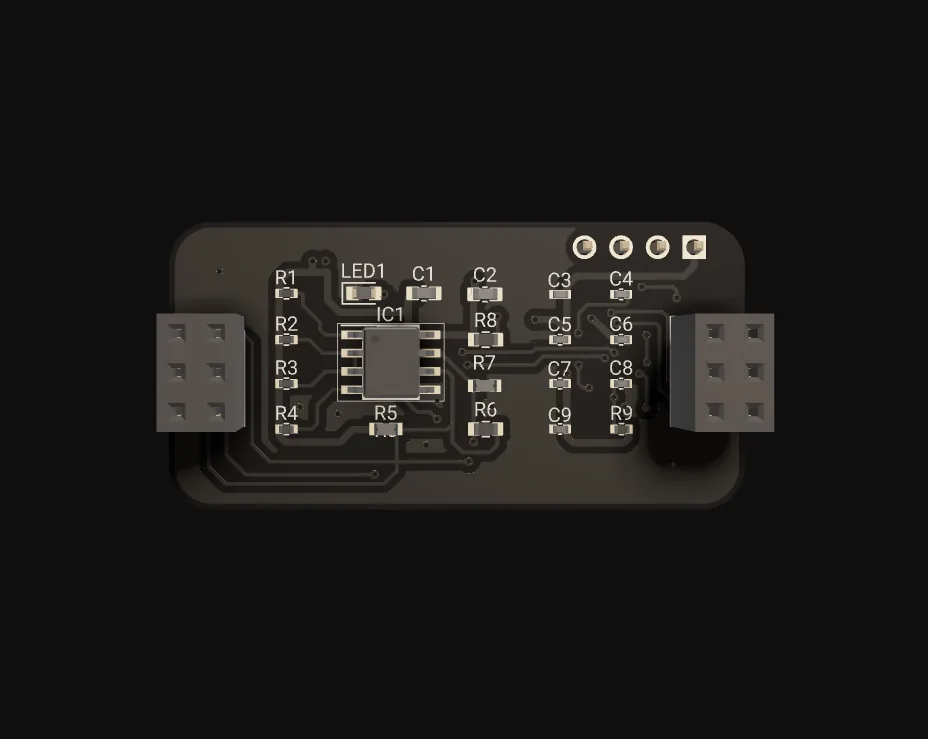
Keep the readers, replace the panel
Every retrofit hits the same wall: the Wiegand readers on the wall still work, but the panel behind them has no central management, no encryption on the bus and no audit trail. Replacing readers means wall plates, cable runs, painting and labour. AXON AMS (W2R-N) keeps the reader and replaces the part that actually needs replacing — the panel and the bus. One unit is installed behind each existing reader, normally in the same back box, and the reader's D0, D1, V+ and GND terminate on it instead of on a long run back to the old panel.
From the module onward the credential travels on the AXON RS-485 bus. Many units share one shielded twisted pair back to the AXON master that owns that bus — a floor Node in front of the ICM-GE in a building, the CCU-32 in a cabin, or the ICM-LR on a distributed site — and each unit carries its own network address, so the master knows which door produced which read. The single-cable Wiegand topology becomes a multi-drop bus, and the cleartext Wiegand path shrinks from tens of metres of riser cable to a few centimetres inside the back box.
The module makes no access decision and holds no user database; the controller decides from its own local table. Two firmware modes are set at commissioning: Converter mode (Wiegand in, RS-485 out) and Simple Node mode, where the same hardware acts as a plain addressed bus endpoint for digital input or relay drive. An RS-485 + Pass-through variant additionally forwards the original Wiegand stream to the legacy panel, so the old and new systems can run in parallel until the cutover is proven.
What the board does for the site
Wiegand 26/34 capture with parity
Captures the D0/D1 pulse train from any standard 26-bit or 34-bit Wiegand reader and validates the frame parity before forwarding. Custom Wiegand formats are configured per project at commissioning — send a sample capture during quoting if your readers emit a non-standard format.
Addressed RS-485 output
Packages each validated credential as an AXON RS-485 bus message carrying the unit's network address and the credential payload. Many units share one twisted pair in a linear multi-drop bus, terminated with 120 Ω at both physical ends only, back to the AXON controller.
Pass-through for phased cutover
The RS-485 + Pass-through variant forwards the original Wiegand stream to the legacy panel while sending RS-485 to the new controller. Both systems process the same reads during migration; once the new controller is validated, the pass-through is disabled and the old panel removed.
Converter or Simple Node mode
Same hardware, two firmware modes chosen at commissioning. Converter mode is Wiegand in, RS-485 out. Simple Node mode drops the Wiegand stage and runs the board as a basic addressed bus endpoint — digital input read or relay drive — reporting state to the controller.
Per-door audit at the controller
Because every unit has its own bus address, the controller logs which converter produced each event. A read at the back door cannot be confused with one at the front door, and the resulting per-door audit trail is something unaddressed legacy Wiegand panels generally do not provide.
12 V DC from the reader feed
Runs on 12 V DC at low draw and passes V+/GND through to the reader, so it is normally powered from the reader supply already present at the location. Verify that supply has headroom for the added load; no new power run is required in the common case.
One read at a converted door, end-to-end
Card at the legacy reader
The user presents a card to the existing Wiegand reader. The reader behaves exactly as before and emits its bit stream on D0 and D1.
Capture and validate
The converter, wired directly behind the reader, captures the pulses and checks frame parity for 26/34-bit formats, or the vendor rules configured for a custom format.
Package and transmit
The credential is wrapped in an AXON RS-485 bus message with the unit's network address and sent over the shared pair to the controller.
Master decides and acts
The AXON master — ICM-GE via its floor Node, ICM-LR, or the cabin master — looks up the credential locally, applies policy and drives the door relay.
Wiegand in, RS-485 out, pass-through optional
Wiegand 26/34
Wiegand is a two-wire pulsed signal with no addressing, no encryption and only parity for error checking. Here it is confined to a short stub between the reader and the converter inside the back box, so reading the cleartext credential requires removing the wall plate rather than tapping the riser cable.
D0/D1 · short stub in the back boxAXON RS-485 bus
From the converter onward the credential travels on RS-485 per TIA-485-A: one shielded twisted pair, linear multi-drop, 120 Ω at both physical ends. Each unit is individually addressed, and the same bus can carry URX-Secure readers on new doors, so the controller sees one fleet of addressed endpoints.
TIA-485-A · multi-drop · 120 Ω endsWiegand pass-through
In the RS-485 + Pass-through variant the converter also forwards the original Wiegand stream to the legacy panel. New controller and old panel process the same reads side by side until cutover; then the pass-through is disabled. Route the new RS-485 pair separately from the retained Wiegand cable to avoid coupling.
Legacy panel stays live during cutoverThe numbers, from the datasheet
Values below come from the engineering deep-dive and catalogue page. Electrical limits not stated there are omitted rather than estimated.
| Role | Wiegand → RS-485 converter / addressed bus node |
|---|---|
| Modes | Converter · Simple Node (set at commissioning) |
| Deployment | One unit per legacy reader, in the reader back box |
| Decision logic | None on board — the AXON controller decides |
| Masters | ICM-GE (via floor Node), ICM-LR, CCU-32 cabin master |
| Formats | Wiegand 26-bit and 34-bit |
|---|---|
| Custom formats | Per project, on request (share a sample capture) |
| Validation | Parity check on standard frames |
| Lines | D0, D1, V+, GND from the reader |
| Interface | RS-485 (TIA-485-A), half-duplex multi-drop |
|---|---|
| Cable | Shielded twisted pair, linear bus |
| Termination | 120 Ω at both physical ends only |
| Addressing | Unique per-unit address, assigned at commissioning |
| Shared with | URX-Secure readers and other AXON nodes |
| Pass-through | Optional variant: Wiegand D0/D1 out to legacy panel |
| Input | 12 V DC |
|---|---|
| Consumption | Low — normally shared with the reader supply |
| Reader power | V+ / GND passed through to the reader |
| Cleartext exposure | Wiegand stub only, inside the back box |
|---|---|
| Bus path | AXON RS-485 bus: encrypted, anti-replay counters |
| Addressability | Per-unit address → per-door audit at controller |
| Card layer | Unchanged — pair DESFire EV3 / URX-Secure for anti-clone |
| Mounting | Existing reader back box; extension ring if shallow |
|---|---|
| Availability | In stock, Kosovo |
| Lead time | Typically 1–2 weeks from local stock |
| Made in | Kosovo |
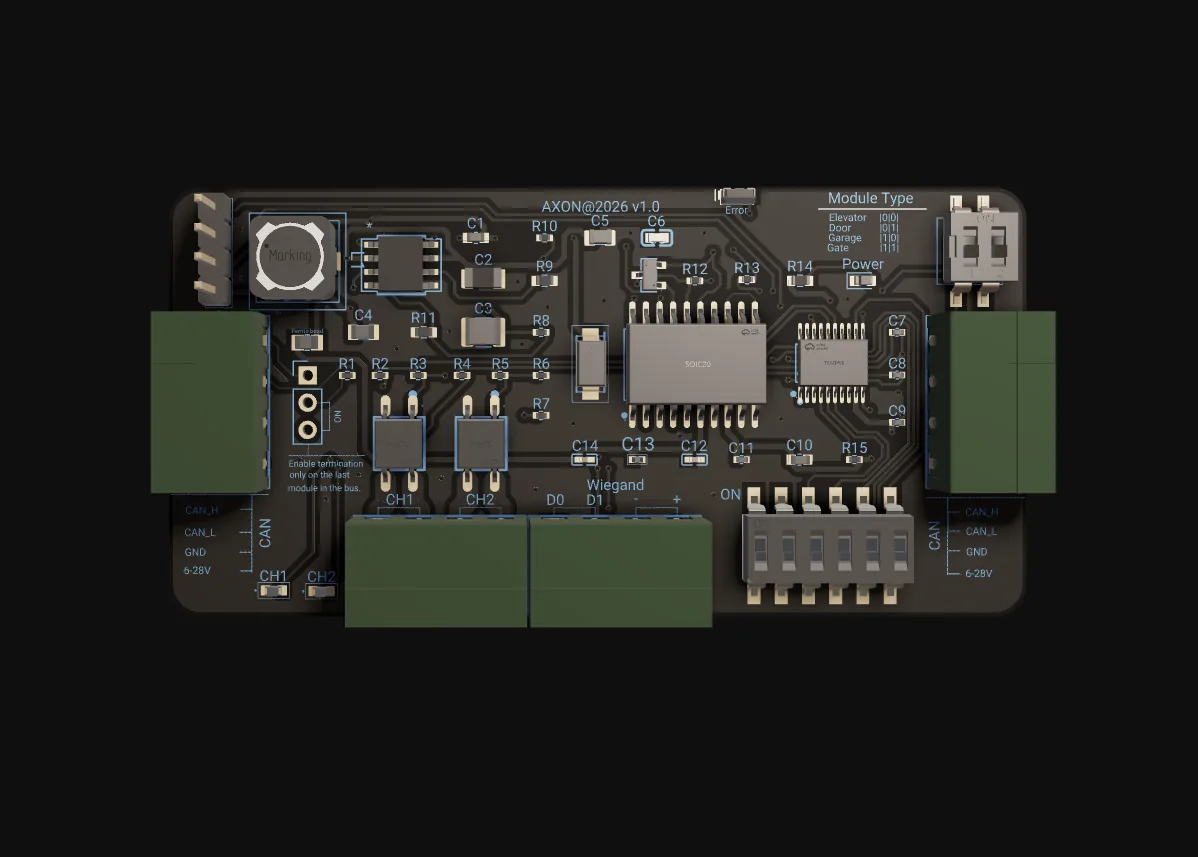
Terminals & connectors
From the legacy reader. Short stub inside the back box — centimetres, not metres.
Passed through to the legacy reader from the local 12 V supply.
To the AXON controller. Twisted pair, multi-drop bus shared with other converters and nodes.
To the legacy panel. Present and active only on the RS-485 + Pass-through variant.
Module power. Share the existing reader supply where it has headroom.
Per-unit network address for identification on the bus. Plan the scheme so addresses map to floor plans.
How the converter compares to other retrofit routes
| Aspect | AXON AMS (W2R-N) | Other retrofit routes |
|---|---|---|
| Rip-and-replace with new encrypted readers | Keeps readers, wall plates, back boxes; replaces only panel and bus | Cleanest end state, highest up-front cost — every reader and cable |
| OSDP retrofit | Works with any Wiegand 26/34 reader, no reader support required | Viable only if the installed reader supports OSDP — most regional stock does not |
| Wiegand repeaters / extenders | Fixes cable length, cleartext transport, and missing addressing/audit together | Solve cable length only; credential stays cleartext and unaddressed |
| Per-reader IP gateways | One shielded pair across all readers | Need structured cabling to every reader location |
AXON RS485 Module, up close
Where AXON AMS (W2R-N) fits
Typical configurations we size for integrators. Every scenario below is a planning example, not a customer reference.
End-of-life panel, readers still fine
A 1990s apartment building has 24 Wiegand readers on entrances and floors, all wired to a failing panel cabinet. Converters go behind each reader in the existing back boxes, one RS-485 pair is pulled through existing conduit, and an ICM-GE with its floor Nodes replaces the panel. Cards keep working; the manager gains central user management and audit.
Two-week parallel run before cutover
A six-floor office with mixed Wiegand and proximity readers migrates during an IT refresh. Pass-through variants are installed so the new ICM-GE validates against the same card population as the legacy panel for two weeks. Tenants see no downtime; once cutover is proven, pass-through is disabled and the old panel removed.
Migration spread over a budget cycle
A regional hospital upgrades access one ward at a time. Migrated wards run on the new controller with a converter at each ward door; wards still on the legacy system are untouched. The project becomes a series of small steps across a budget cycle instead of one capital expenditure and one risky flag day.
Mixed reader vintages, one bus
A yard operator has readers of different ages at different gates and wants to standardise the panel side without touching the reader side. Each gate gets a converter regardless of reader vintage; an ICM-LR, chosen because the gates are spread across the site, sees a uniform fleet of addressed RS-485 endpoints behind a mixed reader population.
AXON AMS (W2R-N) FAQ
What does the converter actually do?
Why not run Wiegand straight to the new controller?
What is the difference between Converter mode and Simple Node mode?
Which Wiegand formats are supported?
Does it improve the security of the cards themselves?
Can it work with non-AXON controllers?
The rest of the AXON system
Ready to specify AXON AMS (W2R-N)?
Tell us how many legacy readers you have, their Wiegand format, and whether the old panel must stay live during cutover. We size the RS-485 bus and controller for you. Standard variants ship from local stock in Kosovo, typically within one to two weeks.