AXON Long-Range
Long-range master for sites where cable between locations is the limiting cost. A LoRa link reaches remote nodes up to ~1 km line-of-sight, a local RS-485 BUS drives readers and relays at each point, and the decision stays on the master.
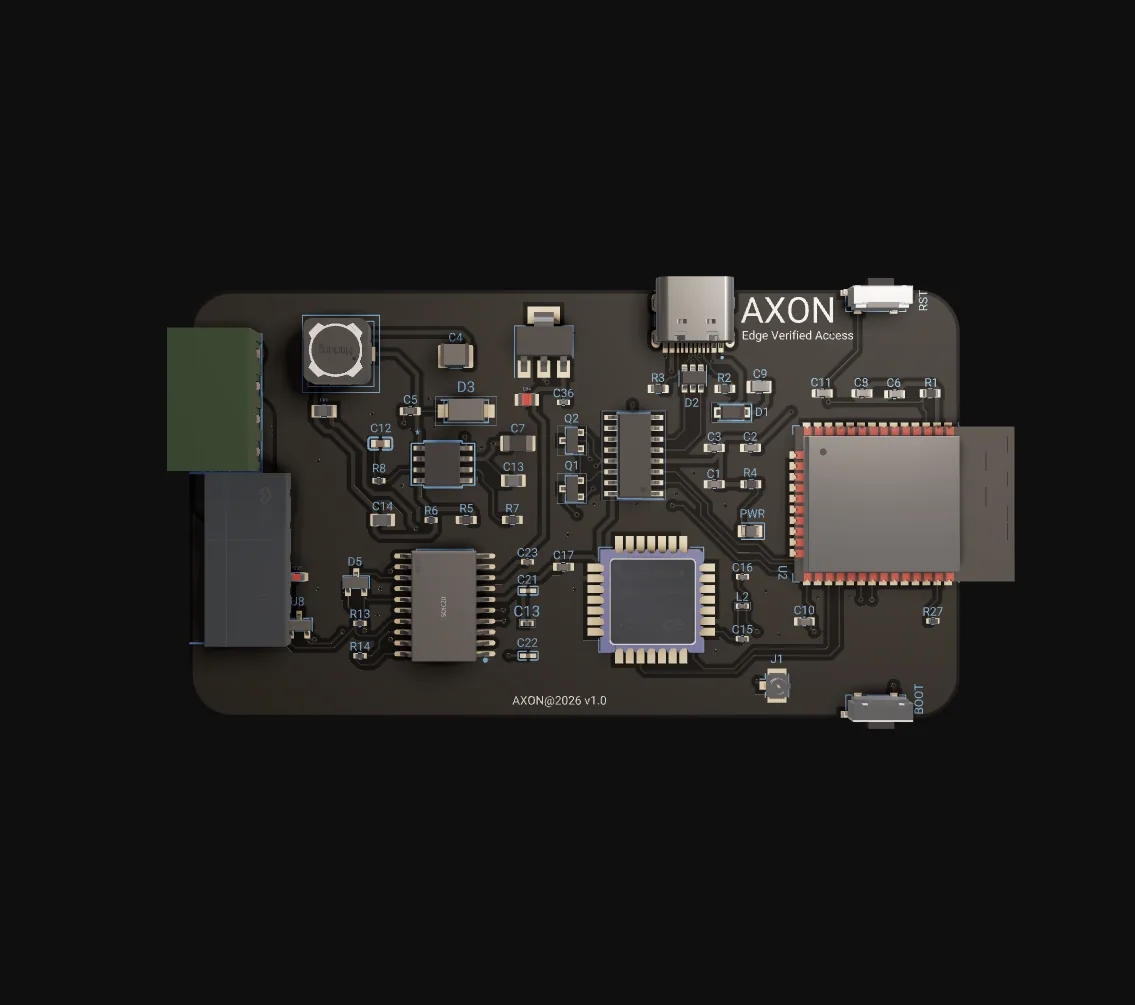
Reach where cable does not pay
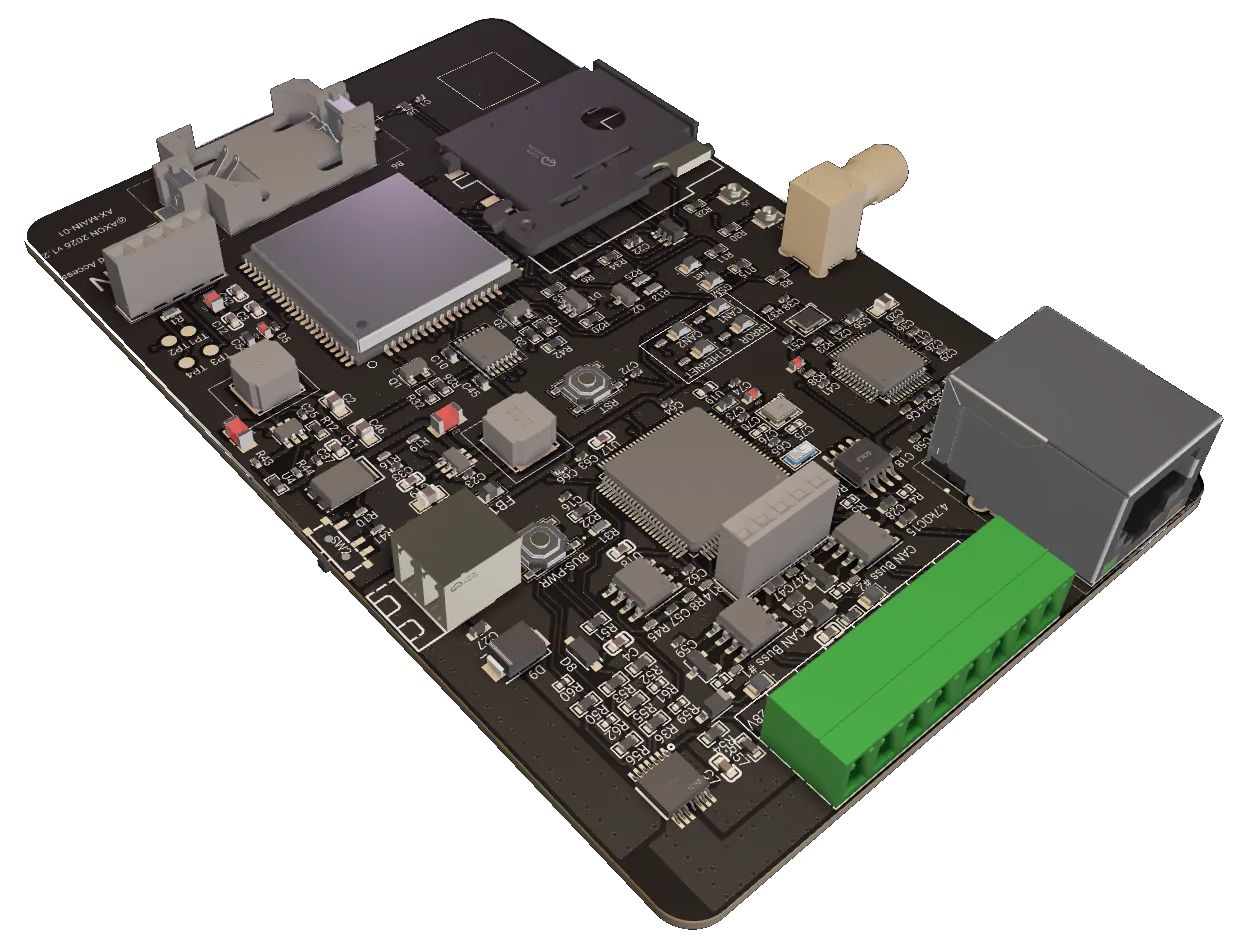
AXON ICM-LR is the long-range variant of the AXON master. Where ICM-GE assumes a building with structured cabling and an Ethernet drop, ICM-LR assumes a site where running cable between locations is the limiting cost: a logistics yard with the gatehouse on one side and the truck gate on the other, a residential complex with visitor parking 400 m away, a hospital campus with a remote staff entrance. It uses a LoRa radio link, up to about 1 km line-of-sight, to reach remote nodes where Ethernet, Wi-Fi and direct cabling all fail on cost or installability.
The LoRa link is not a thin-terminal link to a remote brain. ICM-LR holds the local user database and makes the authorisation decision itself, in milliseconds, even when the management server is unreachable. LoRa carries only the encrypted request from the remote node and the encrypted response back. At each location the master drives a conventional RS-485 BUS to readers and I/O, so a remote barrier point is a small package: one URX-Secure reader, one relay node, one LoRa-attached aggregator that talks back to the master over the air instead of over a trench.
LoRa trades bandwidth for reach. A few-byte access message takes hundreds of milliseconds of airtime, which is fine for a barrier or pedestrian gate and wrong for a high-throughput turnstile; put an ICM-GE at those points instead. Everything that needs bandwidth — server sync, audit-log push, OTA firmware — still goes over the master's wired Ethernet or GSM uplink, never over LoRa. ICM-LR is offered in 500 m and 1 km range configurations and in single-segment or multi-segment architecture; pick from a site survey with the real radio, not from the brochure figure.
What the board does for the site
LoRa reach up to ~1 km LOS
Sub-GHz chirp spread-spectrum radio in the EU 868 MHz ISM band, licence-free for low-power use in Kosovo, Albania and the EU under ETSI EN 300 220. Roughly 1 km in the open with antennas above roof line, 300–500 m through one or two walls, 100–200 m through dense obstruction. Survey every link.
End-to-end encryption
Every authorisation message is encrypted at the originating node and decrypted at the destination, with an anti-replay counter against record-and-replay. A hobbyist SDR receiver can capture LoRa frames; it sees ciphertext. The RS-485 legs on both sides of the radio link are encrypted too. No plaintext credential exists on the path.
Local decision on the master
The user database lives on ICM-LR. The LoRa link delivers the request; the master decides in milliseconds and answers with the gate command and the reader feedback pattern. A dead management server changes nothing at the gate. Events are logged locally and synced when the master's own uplink returns.
Local RS-485 BUS at every point
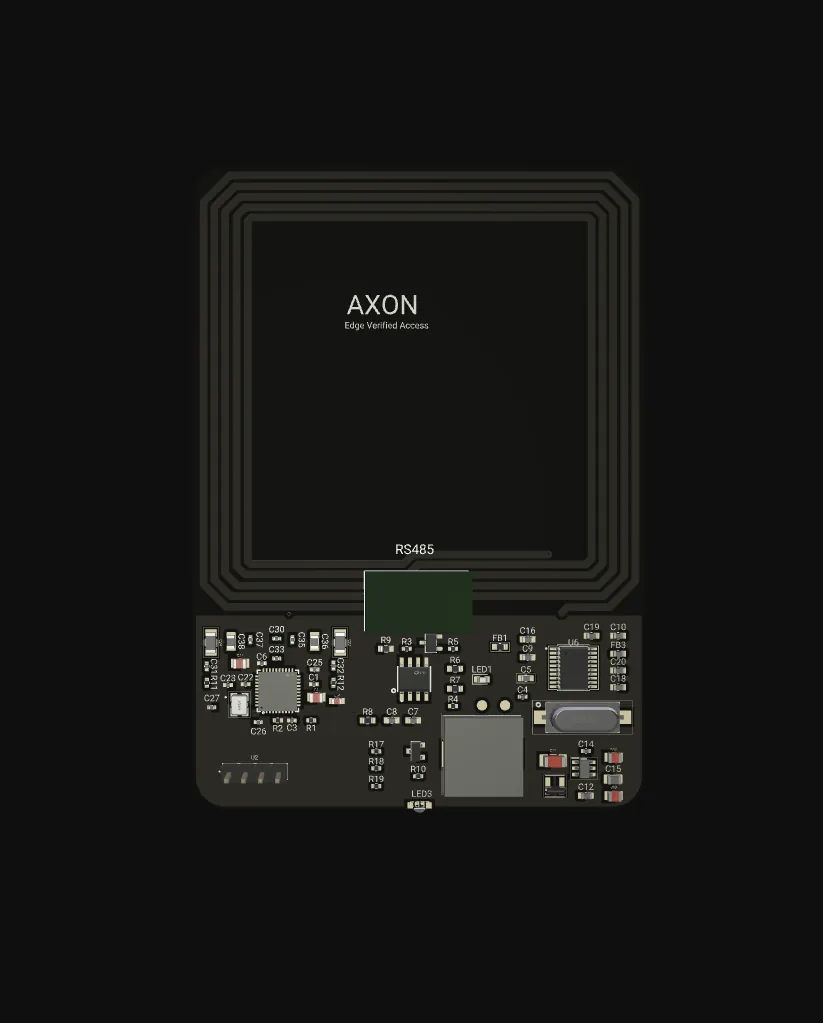
Each remote location runs a short RS-485 BUS for readers and relays, the same physical layer as the rest of the AXON system. URX-Secure readers and W2R-N converters work behind ICM-LR as they do elsewhere in the AXON system. Keep local runs short; a long local bus defeats the point of going wireless.
Per-link keys, bounded retries
Each remote node pairs with the master under its own key, so compromising one remote does not expose the whole site; hardware-rooted key derivation is on the roadmap. If a link degrades, firmware backs off instead of flooding the radio with retries that would breach the regulatory duty cycle.
Wired uplink, LoRa for the site
Server sync, audit-log push and OTA firmware go over the master's Ethernet or GSM uplink, never over LoRa. The radio carries site-internal authorisation traffic only, in a star: master at the centre, remote nodes around it, no repeating through remotes. Two range configurations (500 m, 1 km) and single- or multi-segment topology.
One tap at a remote gate, end-to-end
Capture on the local bus
A card is presented to a URX-Secure reader at the remote gate. The reader sends the credential to the LoRa node over encrypted RS-485 with an anti-replay counter.
LoRa uplink to the master
The remote node packages the request as a LoRa frame and transmits it. The frame carries ciphertext, not the credential.
Master decides locally
ICM-LR decrypts the request, looks up the user and site policy in its local database, and sends an encrypted response with the gate command and reader feedback pattern.
Execute and log
The remote node energises the barrier or door relay over its local RS-485 BUS, the reader acknowledges the user, and the master logs the event, syncing once its uplink allows.
LoRa for reach, RS-485 for the last metres
LoRa, EU 868 MHz
Chirp spread-spectrum in the sub-GHz ISM band; it needs only the two endpoints — no carrier, SIM or access point at the gate. Star topology with the master at the centre. Airtime per message is hundreds of milliseconds and regional duty-cycle limits are respected by default, so heartbeat rates matter. Antenna outdoors, above roof line, on SMA.
ETSI EN 300 220 · licence-freeRS-485 BUS per location
A / B / GND terminals, one or more segments per master, shielded twisted pair with 120 Ω termination at both physical ends only. Runs are short — a few metres to the local readers and relays. Same encrypted secure layer and the same URX-Secure and W2R-N devices as elsewhere in the AXON system.
TIA-485-A · 120 Ω terminationEthernet or GSM on the master
Server sync, audit-log push and OTA go over the master's wired Ethernet or GSM link, not over LoRa; provision it so those still work. Status LEDs show power, LoRa activity, bus activity and uplink state; a service port handles site survey, address provisioning and key loading.
Sync · log push · OTAThe numbers, from the datasheet
Values from the ICM-LR engineering documentation (May 2026). Range figures are line-of-sight in optimal conditions; real range depends on obstructions and must be confirmed by site survey.
| Role | Long-range access control master |
|---|---|
| Decision | Local, on-board user database, offline-capable |
| Range configurations | 500 m (pilot-validated) / 1 km (roadmap) |
| Architecture | Single-segment (default) / multi-segment (roadmap) |
| Remote nodes per master | Tens, limited by LoRa airtime and duty cycle |
| Authorisation latency | Few hundred ms; over 1 s at max-range settings |
| Technology | LoRa, chirp spread-spectrum, sub-GHz |
|---|---|
| Band | EU 868 MHz ISM, ETSI EN 300 220 |
| Reach, line-of-sight | ~1 km in optimal conditions |
| Reach, 1–2 interior walls | 300–500 m typical |
| Reach, dense obstruction | 100–200 m, sometimes less |
| Antenna | External outdoor omni or directional, SMA |
| Topology | Star, direct links, no repeating through remotes |
| Local bus | RS-485 BUS, A / B / GND, one or more segments |
|---|---|
| Bus wiring | Shielded twisted pair, 120 Ω at both physical ends |
| Compatible bus devices | URX-Secure reader, W2R-N converter, relay/I-O nodes |
| Uplink | Ethernet or GSM — server sync, log push, OTA |
| Service port | Site survey, address provisioning, key loading |
| Status LEDs | Power, LoRa activity, bus activity, uplink |
| Input | 12 V or 24 V DC |
|---|---|
| Consumption | 3–6 W (master) |
| Protection | Polarity-protected, fused on the bus |
| Remote nodes | Grid, or solar + battery at low-traffic sites |
| LoRa link | End-to-end encrypted, anti-replay counter |
|---|---|
| Local RS-485 BUS | Encrypted, anti-replay counter |
| Keys | Per-link key per remote node |
| Retry policy | Bounded, duty-cycle aware |
| Decision path | Local-first, no cloud round-trip |
| Enclosure | IP65 cabinet when installed outdoors |
|---|---|
| Antenna placement | Outdoor, above roof line, clear of large metal |
| Cabling | Cable glands, service loop on outdoor runs |
Terminals & connectors
External outdoor antenna for the long-range link. Placement is critical: outdoors, above roof line, away from large metal objects, never inside the cabinet.
Local node bus, one or more segments per master. Shielded twisted pair, 120 Ω termination at both physical ends only.
12 V or 24 V DC, polarity-protected, fused on the bus.
To the management server for sync, log push and OTA. LoRa never carries server traffic.
Power, LoRa activity, bus activity, uplink status.
Commissioning: site survey, address provisioning, key loading.
How ICM-LR compares to other ways of reaching a remote gate
| Aspect | AXON ICM-LR | Alternatives for remote points |
|---|---|---|
| Wi-Fi at each remote point | LoRa link needs only the two endpoints — no access points or backhaul at the remote | Access points and backhaul at every remote; range without repeaters does not span the distances |
| Cellular at each remote node | No per-node SIM; works where mobile coverage is absent at the gate | SIM cost per node plus coverage uncertainty at outbuildings, basements and rural perimeters |
| Trenched cable to every point | Removes most of the trenching; accepts LoRa latency and bandwidth limits | Highest reliability, often the highest cost on a fragmented site |
| Stand-alone offline controllers | Central user management and aggregated audit logs without the cable burden | Simple, but users enrolled at each controller and logs never aggregate |
AXON Long-Range, up close
Where AXON ICM-LR fits
Typical configurations we size for integrators. Every scenario below is a planning example, not a customer reference.
Truck gate across an active yard
The security cabin sits by the office and the truck gate 600 m across the yard. ICM-LR lives in the cabin; a LoRa-attached node at the gate drives a URX-Secure reader and the boom solenoid. Drivers tap, the master authorises in under a second, the boom lifts. Trenching across a working yard would cost more than the whole system.
ICM-GE inside, ICM-LR for the outbuildings
A campus with detached buildings and a perimeter pedestrian gate runs an ICM-GE in the main building for the wired doors and an ICM-LR alongside it for outlying buildings and gates. User changes reach both masters from the management server, so policy is consistent everywhere while cabling costs a fraction of fibre to every outbuilding.
Overflow lot with its own barrier
Main customer parking is next to the store; an overflow lot 300 m away has a ramp barrier for staff and contractors. ICM-LR sits in the store's IT closet and a LoRa-attached node drives the overflow barrier. Staff use one card at both lots and the management software reports usage per lot for capacity planning.
Plant rooms reached without trenching
A main building with several outbuildings — mortuary, plant rooms, staff residences — uses ICM-LR at the main IT room to reach each outbuilding without trenching through active grounds. Each outbuilding runs a small local RS-485 BUS; time-window policy sets access per role. Remote nodes are grid-powered; solar is reserved for one gate with no nearby utility.
AXON ICM-LR FAQ
When should I choose ICM-LR over ICM-GE?
What is the realistic LoRa range?
How does end-to-end encryption work?
How many remote nodes can one ICM-LR support?
What power does ICM-LR draw, and can remote nodes run on solar?
Is ICM-LR available today?
The rest of the AXON system
Ready to specify AXON ICM-LR?
Send us a site plan with the distances between the master location and each remote gate. We will advise on range configuration, antenna placement and remote-node packaging, and arrange a LoRa site survey with the production radio before you commit. Pilot units on request.